
It’s 9:47 on a Tuesday night in Hyde Park. Your last table just paid, the line cooks are breaking down the station, and somewhere across Tampa a party of six is standing outside a bar on South Howard trying to decide where to eat this Friday. They pull up your website. They have three quick questions: Do you have a table for six at 7:30? Is the patio dog-friendly? Can we bring a birthday cake? Your host is gone. Your phone rolls to voicemail. Your contact form promises a reply “within 24 hours.” So they close the tab, tap the next result, and book the spot two blocks down that answered them in eleven seconds.
You never saw that party. There’s no missed-call log for a website visit, no voicemail, no trace — just a quiet leak of real demand arriving after the last apron comes off. This is the post about plugging that leak. It’s a straight, numbers-first look at why Tampa restaurants lose bookings after hours, and how a restaurant-tuned AI chatbot turns your website into a 24/7 host that answers, books the table, and hands the warm ones off to a real text conversation.
Table of Contents
- The 30-second answer
- When Tampa diners actually decide (and why no one’s home)
- The real cost of a silent website
- Why “call us” and a contact form don’t cut it anymore
- What an AI chatbot actually does for a restaurant
- The Tampa math: what plugging the leak is worth
- Doing it right: fast, on-brand, and compliant
- Frequently asked questions
The 30-Second Answer
Tampa restaurants lose after-hours bookings because most guests research and decide on your website when no staff is available to answer — and the ones who can’t get a fast answer book a competitor. An AI chatbot fixes it by acting as a 24/7 digital host: it responds in seconds to the questions your team answers all day, checks availability and books the table inside the chat, captures the guest’s mobile number, and escalates anything complex to a real person or a text thread.
This isn’t about replacing your host. It’s about covering the hours your host can’t — the 9 PM to 11 PM window when a couple is deciding on Friday’s anniversary dinner, the Sunday afternoon when someone’s planning a rehearsal dinner, the lunch rush when every line is busy and the phone just rings. Those moments are where covers quietly disappear. The rest of this post shows the evidence, the math, and how to install one without annoying a single guest.
When Tampa Diners Actually Decide (and Why No One’s Home)
Restaurant demand doesn’t keep restaurant hours. Guests research on their own schedule — on the couch, on the sidewalk, mid-scroll — and overwhelmingly on their phones. The decision happens on your website: 85% of diners look at a restaurant’s menu online and 80% look at the website before choosing where to eat, according to TouchBistro’s survey of more than 1,500 U.S. diners (TouchBistro, 2024). And when they book, they increasingly go straight to the source — 65% of diners go directly to a restaurant’s own website to check availability rather than starting on a third-party app (Toast, 2025).
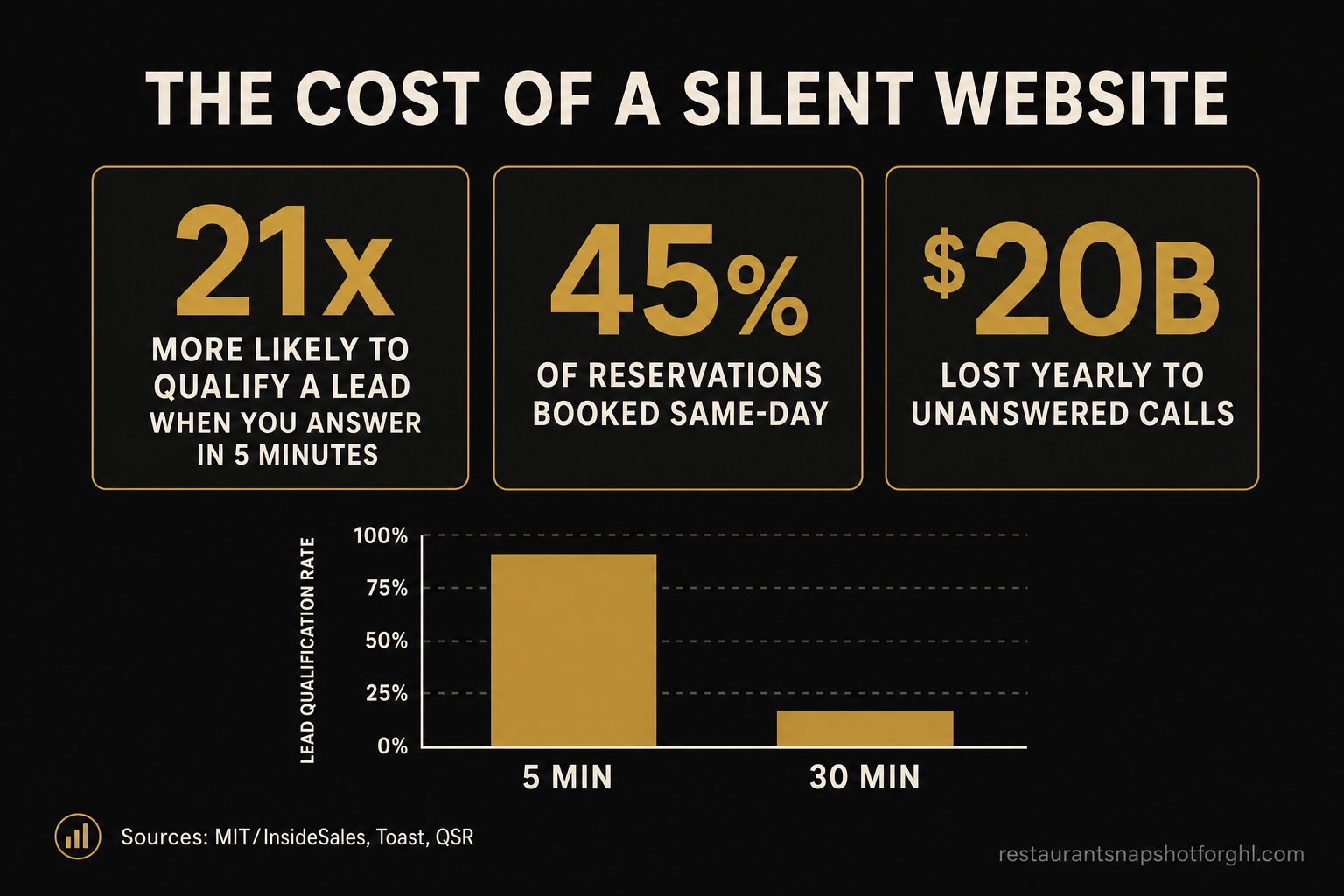
Here’s the part that catches operators off guard: a huge share of that deciding happens off-hours and on impulse. Toast’s booking data shows roughly 45% of reservations are made the same day as the visit (Toast, 2024) — the definition of a spur-of-the-moment decision that won’t wait for business hours. When someone decides at 9:47 PM that they want a table tomorrow, they act now. If your website can’t answer “do you have a table for six at 7:30,” they don’t leave a message. They leave.
Tampa makes that competition unforgiving. Florida’s hospitality industry represents roughly $111.7 billion and about 1.5 million employees, according to the Florida Restaurant & Lodging Association (FRLA) — and from Ybor City to Water Street to the SoHo strip, a hungry guest has a dozen strong options within a rideshare’s reach. In a market that dense, the restaurant that answers first often wins the table, full stop.
The Real Cost of a Silent Website
The cost of a website that can’t answer isn’t abstract — it maps directly to a rule every sales team learned the hard way: speed to lead. In the landmark MIT / InsideSales Lead Response Management study, which analyzed more than 15,000 leads and 100,000 call attempts, businesses that responded to an online inquiry within five minutes were 21× more likely to qualify the lead than those that waited just 30 minutes — and 100× more likely to even make contact (MIT / InsideSales).
That research predates restaurants adopting chat, but the psychology is identical — a diner deciding where to spend Friday night is a lead, and their attention has a shelf life measured in seconds. It lines up with the classic Harvard Business Review audit that found the average company took 42 hours to respond to a web inquiry, and 23% never responded at all (Harvard Business Review, 2011). For a restaurant, “42 hours later” is three dinner services after the guest already ate somewhere else.
The phone tells the same story from a different angle. One industry estimate pegs the revenue U.S. restaurants lose to unanswered phone calls at roughly $20 billion a year (QSR Magazine) — calls that ring out during service, after close, or while the one person who can take a reservation is running food. Your website is that same missed call, minus the ring. It’s demand you never even hear.
Why “Call Us” and a Contact Form Don’t Cut It Anymore
The two default answers on most restaurant websites — a phone number and a contact form — both fail at exactly the moment demand shows up. The phone assumes someone is free to pick it up during service (they rarely are). The contact form assumes the guest will wait patiently for a reply (they won’t). Guest expectations have moved hard toward now: 88% of customers say they expect faster responses than they did a year ago (Zendesk, 2026), and 42% of consumers expect an immediate response from a chatbot (Drift / SurveyMonkey). One live-chat benchmark found roughly 60% of visitors will abandon a chat if they don’t get a response within 60 seconds (Comm100).
This isn’t a fad — it’s where service is heading. Gartner projects that self-service and live chat will surpass traditional channels like phone and email as the top customer-service technologies by 2027 (Gartner, 2025). The restaurants winning the after-hours booking aren’t the ones with the prettiest homepage. They’re the ones that reply instantly when a guest reaches out — the same reason a fast missed-call text-back beats a voicemail, and an AI phone answerer beats a busy signal.
How a Tampa guest's late-night question actually gets answered
| Plan | AI chatbot on your site recommended | Phone number + contact form |
|---|---|---|
| Price | Answers in seconds | Answers tomorrow |
| Feature 1 | Replies instantly, 24/7 — including 9 PM to close and after hours | Phone rings out during service and after close |
| Feature 2 | Answers menu, hours, parking, patio, dietary and private-event questions | Form promises a reply 'within 24 hours' — 42-hour average is common |
| Feature 3 | Checks availability and books the table inside the chat | No availability check; guest can't self-serve a booking |
| Feature 4 | Captures the guest's mobile number and name automatically | Captures a lead only if the guest bothers to fill it out |
| Feature 5 | Hands warm or complex chats to SMS or a real person | No handoff — the thread just dies in an inbox |
| Feature 6 | Logs every conversation into your CRM for follow-up | No record, no follow-up, no idea the guest existed |
| See the AI chatbot → | The status quo |
What an AI Chatbot Actually Does for a Restaurant
“AI chatbot” gets used loosely, so here’s the concrete version for a restaurant. It’s a chat bubble on your website — and, if you want, on Facebook and Instagram — that behaves like a well-trained host who has read your menu, knows your policies, and never goes home. A guest types a question the way they’d ask a person, and it answers immediately, then moves the conversation toward a booked table.
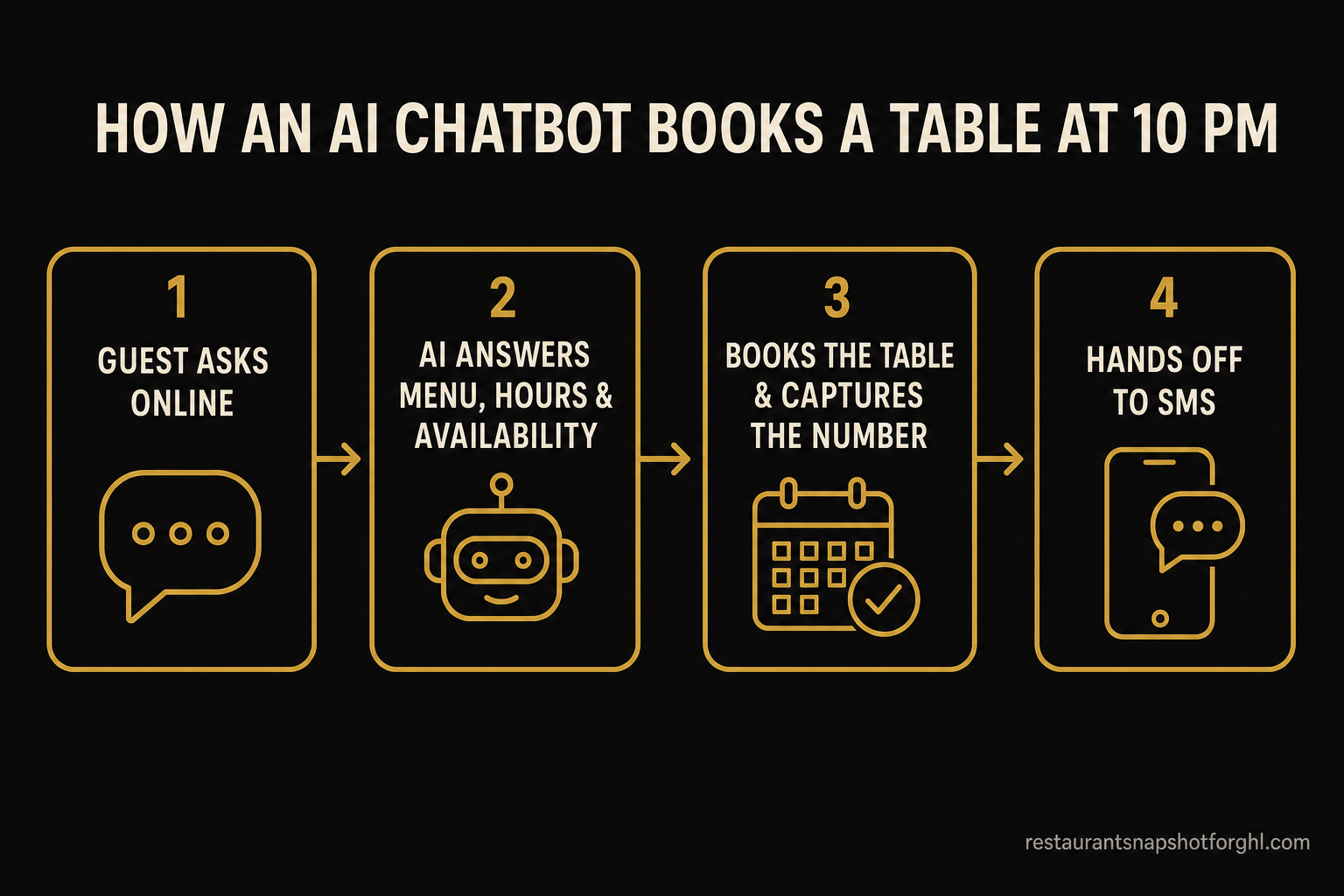
The magic isn’t any single answer — it’s that the chatbot never sleeps and never gets slammed. During your Saturday rush, when every host is running the floor and the phone is a liability, it’s quietly booking the guest who found you on Instagram. At 11 PM, when your team is long gone, it’s answering the anniversary couple and locking in Friday. This is the same digital-host idea we walked through in the Los Angeles AI chat widget guide — here the lens is the after-hours booking specifically, and the Tampa operator losing it.
If you want the concierge-grade version — a bot trained deeply on your concept, wired into your POS and reservation platform, escalating events to your GM with a full brief — that’s an AI Guest Support Agent, the kind of custom build our team scopes for multi-unit operators. For most restaurants, the chatbot that ships inside the Restaurant Snapshot is exactly enough to stop the leak.
The Tampa Math: What Plugging the Leak Is Worth
Let’s keep this honest — no revenue guarantees, just arithmetic you can run against your own numbers. Say your website gets 60 unique visitors on a typical evening after 8 PM (modest for a well-reviewed Tampa spot). Suppose just 5% of them have a real question standing between them and a booking — that’s three guests a night. Today, most of those three go unanswered and a chunk book elsewhere. If an always-on chatbot converts even one of them into a table of two, at a $55 average per-person check that’s roughly $110 a night — call it $3,000+ a month in covers you were otherwise leaking, plus the guest data to bring them back.
Now layer on retention. Every captured mobile number is a future SMS special or win-back — the guest you almost lost becomes a regular you own. That’s the real return: the chatbot isn’t just answering a question, it’s starting a relationship your competitor never got to. Run the same math with your covers, your check average, and your traffic; even conservative inputs tend to make an AI chatbot one of the cheapest tables you’ll ever add.
Doing It Right: Fast, On-Brand, and Compliant
A chatbot done badly is worse than none — a clunky bot that misreads questions or texts people without consent erodes trust fast. Three things separate a booking machine from a nuisance.
It has to be fast underneath. A chat widget can’t rescue a page that takes five seconds to load; the guest bounces before the bubble even appears. If your current site is slow or a pain to edit, fix the foundation first with a purpose-built restaurant website, then layer the chatbot on top. Speed is the whole premise — don’t undercut it with a heavy homepage.
It has to sound like you. The bot should answer in your restaurant’s voice, know your actual policies, and escalate the moment a question needs a human. A guest should feel helped, not screened. The goal is a host who happens to be software, not a wall that happens to talk.
It has to be compliant. The moment a chat turns into a text, you’re in regulated territory. U.S. business messaging runs under the TCPA and the A2P 10DLC registration system, which require clear consent, sender identification, and automatic STOP opt-out handling. A properly built chatbot captures consent inside the chat and sends only from a registered number — the guardrails we break down in the TCPA and A2P 10DLC guide for restaurants. Get this right and the after-hours booking is a clean win. Get it wrong and it’s a liability. Done-for-you means the compliance is handled before the first text ever fires.
Frequently Asked Questions
AI chatbot for Tampa restaurants — common questions
Why are Tampa restaurants losing bookings after hours?
Because most guests research and decide on your website outside your staffed hours — evenings, late nights, and weekends — and about 45% of reservations are made the same day, on impulse (Toast, 2024). When a guest has a question at 10 PM and your phone rolls to voicemail and your contact form promises a reply 'within 24 hours,' they don't wait. Businesses that respond within five minutes are 21× more likely to qualify a lead than those that wait 30 (MIT/InsideSales), so a slow answer is a booked table lost to whoever replied first.
What does an AI chatbot do for a restaurant website?
It acts as a 24/7 digital host. It answers the common questions your staff field all day (hours, menu, parking, patio, dietary options, private events), checks availability and books the table inside the chat, captures the guest's name and mobile number, and hands complex or high-value conversations (a large buyout, a serious allergy question) to a real person. Unlike a contact form, it responds in seconds, at any hour.
Will an AI chatbot replace my host or staff?
No. It covers the hours and volume your team can't — the after-hours questions, the repeat FAQs during a slammed Saturday service — so your host can focus on running the room. Anything that genuinely needs a person gets routed to a human with the context already gathered. It's coverage, not replacement.
Is it legal to text guests from the chatbot?
Yes, when it's built correctly. U.S. business texting is governed by the TCPA and the A2P 10DLC registration system, which require clear consent, sender identification, and automatic STOP opt-out handling. A properly built chatbot captures consent inside the chat and sends only from a registered number, so you stay compliant from the first message. A done-for-you build handles that registration before any text goes out.
How much does an AI chatbot for a restaurant cost in Tampa?
It's included in the Restaurant Snapshot, a done-for-you GoHighLevel system that installs in 24 hours for a single package price — so you're not paying a separate monthly SaaS fee for the chatbot alone. Deeper custom builds (an AI Guest Support Agent wired into your POS and reservation platform) are scoped separately for multi-unit operators. The fastest way to a real number is a quick walkthrough call.
My website is slow — will a chatbot still help?
Only up to a point. If your page takes several seconds to load, many visitors leave before the chat bubble even appears, so the chatbot never gets a chance. If your current site is slow or hard to update, it's worth moving to a fast, purpose-built restaurant website first, then adding the chatbot on top. We build blazing-fast restaurant sites and install the chatbot as part of the same system.
Marisol spent nine years running front-of-house and marketing for a three-location Tex-Mex group before going all-in on automation. She now designs GoHighLevel snapshots for independent restaurants and small multi-unit operators, with a soft spot for AI booking flows and review pipelines that actually fill slow weeknights. She writes the way she ran her floor: practical, fast, and allergic to fluff.
Related reading
- AI phone answering for restaurants: catch every call you miss
- Missed-call text-back for restaurants
- How to add an AI chat widget to your restaurant website
- Building a restaurant online reservation system that fills tables
- GoHighLevel for restaurants: the complete 2026 guide
Sources
- TouchBistro — 2024 American Diner Trends Report (85% check menu online, 80% the website)
- Toast — 2025 Reservation Data (65% go directly to the restaurant website)
- Toast — Full-Service Reservation & Booking Trends (≈45% same-day bookings)
- MIT / InsideSales — Lead Response Management Study (21× to qualify within 5 minutes)
- Harvard Business Review — The Short Life of Online Sales Leads (42-hour average; 23% never respond)
- Zendesk — CX Trends 2026 (88% expect faster responses than a year ago)
- Drift / SurveyMonkey — State of Conversational Marketing (42% expect an immediate chatbot response)
- Comm100 — Live Chat Benchmark Report (≈60% abandon after 60 seconds)
- Gartner — Self-service & live chat to surpass traditional channels by 2027
- QSR Magazine — Restaurants losing $20 billion to unanswered calls
- Florida Restaurant & Lodging Association — Florida hospitality industry ($111.7B, 1.5M employees)