
It is 9:15 on a slow Tuesday and you are reconciling the day. The DoorDash tablet says you did $312 in orders. The deposit that lands in your account is $214. Somewhere between the two, almost a hundred dollars walked out the back door, and nobody handed you an itemized receipt for it. You know the app “takes a cut.” You are less sure what the cut actually is, because the number you were quoted when you signed up is not the number doing the damage.
Here is the short version. The commission rate on the flyer runs 15% to 30%, but once you add packaging, promotions, payment processing, and the refunds you eat for a cold order, the true cost of a delivery order lands closer to 30% to 45% of the ticket (Restaurant Business, 2025). On a restaurant net margin that usually sits between 3% and 5% (Level CFO, 2026), that is not a cost of doing business. That is your profit, gone.
This is a straight teardown of what each app charges in 2026, a worksheet you can run on your own numbers in five minutes, and a plan to move some of those orders onto a channel you actually own.
Table of Contents
- The 30-second answer
- Why the commission you were quoted is never the commission you pay
- What each app actually charges in 2026
- The real math on one $30 order
- Run your own numbers: the delivery-cost worksheet
- Three restaurants, three very different bills
- How to move orders direct without losing the delivery
- The compliance line nobody mentions
- Where your city changes the math
- Objections, answered straight
- Frequently asked questions
The 30-Second Answer
A third-party delivery order costs an independent restaurant roughly a third of the ticket, and often more. The published commission is 15% to 30% depending on app and plan tier, and the all-in cost after packaging, promotions, processing, and refunds pushes toward 30% to 45%. The apps buy you visibility and drivers. What you give up, on top of the money, is the guest: their name, their phone number, and their next order all live on someone else’s platform.
The single most useful thing you can do is stop guessing the number. Price out one real order, apply it to a normal week, and you will know whether delivery is a lead generator you tolerate or a leak you need to cap.
Why the Commission You Were Quoted Is Never the Commission You Pay
When a sales rep says “15%,” they mean the base marketplace commission on the food subtotal. That is one line on a bill with five or six. Here is what rides along with it.
Plan tier. Every app sells the low rate as the entry plan and reserves the good placement, search ranking, and promotional tools for the higher tiers at 25% or 30%. The cheap plan is real, but it buries you in the app.
Payment processing. Grubhub, for example, adds a 3.05% plus $0.30 processing fee on top of its commission (Grubhub, 2026), stacked on top of it, not instead.
Promotions and ads. “Run a $0 delivery fee promo” and “buy sponsored placement” are pitched as optional, but once a competitor down the street runs them, opting out means disappearing. That is commission by another name.
Packaging and the refund tax. Delivery needs containers, bags, and labels that dine-in does not. And when a driver is slow or an item is missing, the app often refunds the customer and charges you: you paid to make the food, paid the commission, then paid it back.
Add those up and the gap between the quoted 15% and the real 35% is not an accident. It is the model. The National Restaurant Association projects $1.55 trillion in 2026 industry sales (NRA, 2026), yet the operators inside that number run on thin single-digit margins. A 35% take on a growing slice of your orders is the difference between a good year and a flat one.
What Each App Actually Charges in 2026
All three platforms use a tiered model now: a low headline rate for the cheap plan, a higher rate for the plan that actually gets you seen. Here is where each one sits.
DoorDash
DoorDash sells three partnership plans. Marketplace delivery commission is 15% on Basic, 25% on Plus, and 30% on Premier, with pickup charged at 6% across all three (DoorDash, 2026). Basic is the cheapest way to be on the app, but Plus and Premier are where you reach the frequent, higher-spending DashPass subscribers, so most restaurants that lean on DoorDash end up at 25% or 30%.
Uber Eats
Uber Eats moved its rates up. The entry Lite tier rose to 20% from the old 15%, Plus sits at 25% (with an extra 5% on orders from Uber One members), and Premium remains at 30% (Restaurant Dive, 2025). Pickup ticked up from 6% to 7%. As with DoorDash, the visible plan is the expensive one.
Grubhub
Grubhub splits the bill into pieces, which makes it look cheaper than it is. The marketing commission runs 5% for Basic, 15% for Plus, and 20% for All-access. On top sits a 10% delivery fee if you use Grubhub’s drivers (zero if you deliver yourself), plus the 3.05% + $0.30 processing fee (Grubhub, 2026). So a Plus-plan restaurant using Grubhub delivery pays roughly 25% all in, right in line with the others.
Published marketplace delivery commission by plan tier, 2026. Sources: DoorDash, Restaurant Dive, Grubhub. Figures exclude promotions, packaging, and refunds.
The Real Math on One $30 Order
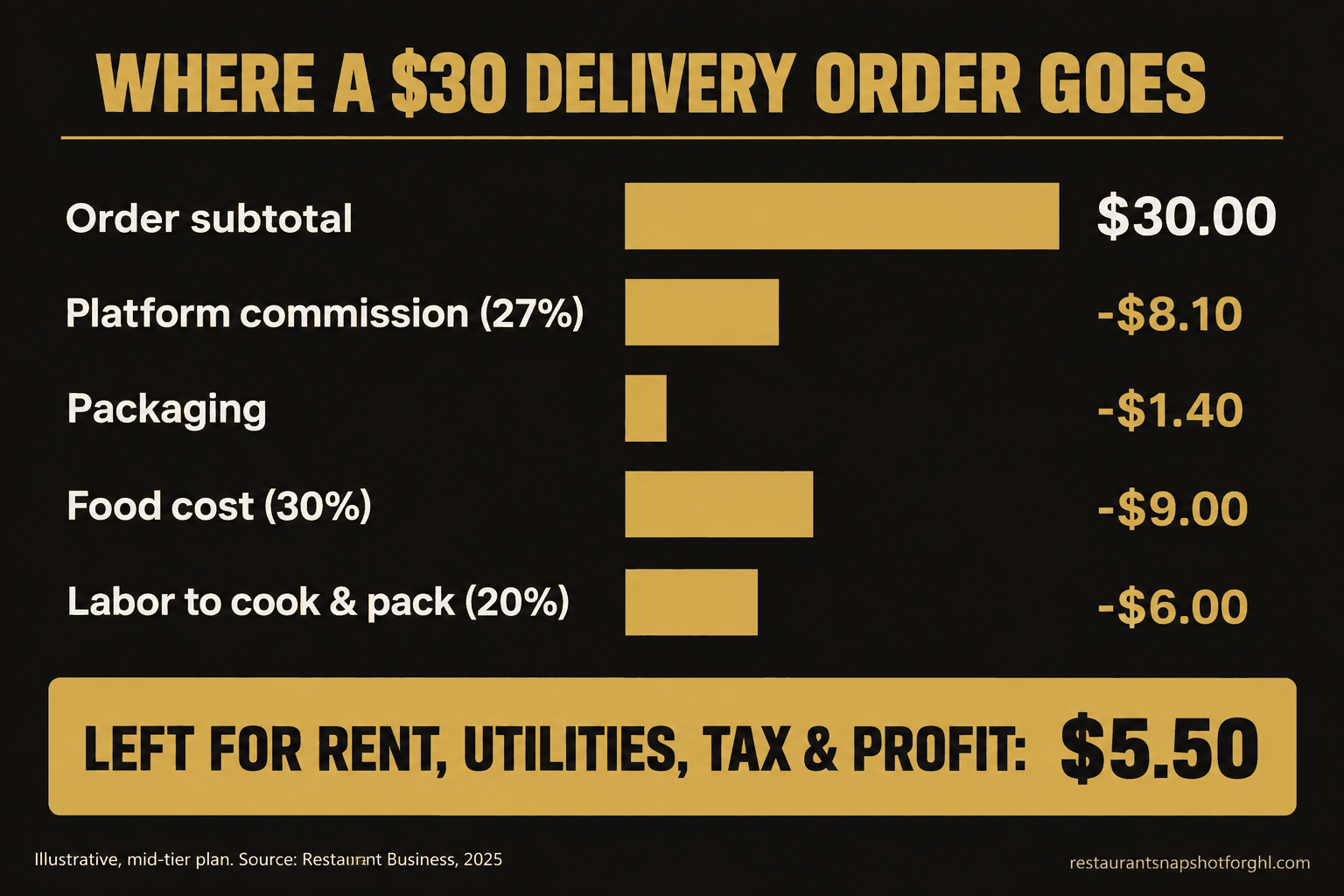
Percentages are easy to wave away. Dollars are not. Take one order: $30 of food on a mid-tier plan at a 27% effective commission, on food that costs 30% to make. Here is where the $30 goes.
| Line | Amount | Running total kept |
|---|---|---|
| Order subtotal | $30.00 | $30.00 |
| Platform commission (27%) | -$8.10 | $21.90 |
| Packaging (bag, containers, label) | -$1.40 | $20.50 |
| Food cost (30% of subtotal) | -$9.00 | $11.50 |
| Labor to cook and pack (est. 20%) | -$6.00 | $5.50 |
| Left for rent, utilities, tax, profit | $5.50 |
That $5.50 is before the refund you eat on a missing side and before the promo you ran to stay visible. Run the same order at a 35% all-in cost and the kitchen keeps about $4.00. This is the math that has operators pumping the brakes on delivery even as it grows (Restaurant Business, 2025). On a lot of tickets, delivery is barely any money at all.
Run Your Own Numbers: The Delivery-Cost Worksheet
Your kitchen is not the example above. Pull last month’s payout report from each app, grab a calculator, and fill in five lines. It is the most valuable five minutes you will spend on your delivery program this year.
The point of line 5 is not to quit the apps. It is to size the prize. Once you see that moving even a quarter of your orders to a channel you own is worth five figures a year, setting one up stops being a “someday” project.
Three Restaurants, Three Very Different Bills
The same rate card lands very differently depending on volume. Run the worksheet for three archetypes and the strategy changes at each size.
The solo spot. One location, roughly $8,000 a month in third-party delivery. At a 28% effective rate, that is about $2,240 a month, or $26,880 a year. Here delivery is genuine incremental demand, so the move is not to quit. It is to add a commission-free order button on your own site and steer regulars to it, one text at a time.
The busy independent. One high-volume location doing about $22,000 a month at a 30% effective rate. That is $6,600 a month, or $79,200 a year. At this level a direct channel is not optional: moving even 30% of orders off-app is worth more than $23,000 a year, which pays for a website, an ordering tool, and the staff time to run it.
The small group. Three locations totaling roughly $55,000 a month in delivery. At 30%, that is $16,500 a month, or $198,000 a year. Treat the apps as a paid acquisition channel with a hard budget: win a first-time guest, then move them to your own list and ordering page so the next orders come commission-free.
How to Move Orders Direct Without Losing the Delivery
Most operators think the choice is “apps or nothing.” It is not. The apps are good at one thing: putting you in front of someone who has never heard of you. Where they rob you is on the repeat order from a guest who already loves your food. Here is the play.
Step 1: Put a commission-free order button on a site you own. Both Toast and Square let you take pickup and delivery orders from your own branded page and keep 100% of the ticket, with no per-order commission to a marketplace (Toast, 2026). You pay a flat monthly fee instead of a percentage, so the math flips in your favor the busier you get. A slow or clunky site quietly sends people back to the app, so if you do not have a fast one to hang that button on, fix that first. Our prebuilt restaurant website and website build service exist for this.
How it breaks: operators bolt a direct-order button onto their site and never tell anyone it exists. The button is not the product. The habit is.
Step 2: Capture the guest so you can reach them again. Every third-party order is a guest whose contact info you never see. Every direct order is a guest you can text next Tuesday. Owning that list is the entire game, and we wrote a full playbook on owning your restaurant guest list. When someone orders direct, capture the number with consent and tag them.
How it breaks: you collect numbers with no plan to use them, or you blast the whole list a daily special and get everyone to opt out in a week. Treat the list like a regular you want to keep, not a channel to drain.
Step 3: Nudge the repeat order with a text, not a hope. This is where the money comes back. A guest who ordered pickup direct last month gets one friendly text: your food, your link, no app markup. The same SMS automation that fills a slow Tuesday can retrain your regulars to skip the app.
How it breaks: you send the text from a personal cell, it is not compliant, and one complaint costs you the number. Which is the next section.
The Compliance Line Nobody Mentions
The moment you text guests to order direct, you are doing SMS marketing, and that is regulated. The TCPA governs consent for marketing texts, and A2P 10DLC is the carrier registration that keeps your messages from getting silently filtered. A restaurant that scrapes phone numbers off delivery tickets and blasts a promo is the textbook violation. We go deep on this in our guide to TCPA compliance for restaurant SMS, but here is the safe version: get explicit opt-in before you text, ideally at the point of the direct order with the terms in plain sight, and keep the opt-out one word away.
The carrier fees are small: A2P 10DLC messaging runs about $0.003 per segment plus a $2 to $10 monthly campaign fee (HighLevel, 2026). Next to a 30% commission, the choice makes itself.
Where Your City Changes the Math
The rate card is national, but the ceiling on it is not. During the pandemic, a wave of cities capped what delivery apps could charge, and a couple made it permanent. San Francisco locked in a 15% cap in July 2021, and New York City followed the next month: 15% on delivery, 5% on non-delivery services like advertising, and a 3% ceiling on transaction fees (Nation’s Restaurant News, 2021). The apps have been fighting those caps in court ever since (Restaurant Dive, 2023), so if you operate in a capped city, check the current status before you assume the lower rate still holds.
If you are in New York or San Francisco, your worst-case commission is legally lower than the 30% an operator in an uncapped market pays, but the caps are contested and the effective cost still climbs with fees the cap does not touch. Everywhere else, the direct channel is your only real cap.
Objections, Answered Straight
“The apps bring me new customers I would never reach. Isn’t that worth it?” For genuinely new customers, often yes. Treat the apps as paid acquisition and the commission as the cost of a first date. The mistake is paying that fee on the hundredth order from a regular who found you two years ago. Win the guest on the app, then move the repeat orders to your own channel.
“Setting up my own ordering sounds like a tech project I do not have time for.” It is smaller than it sounds. Commission-free ordering is an add-on to the POS you already run, and a branded site to hang it on is a done-for-you job, not a weekend build. If you are handing the apps $79,000 a year, a few days of setup is the best-paid work you will do all year.
“My margins are already thin. I cannot afford another monthly fee.” That instinct is right, and it is exactly why the flat-fee model wins. A percentage commission gets more expensive every good month. A flat monthly fee does not. You are trading a cost that scales against you for one that does not, and the busier you get, the more it saves.
Frequently Asked Questions
Delivery-app fees for restaurants: quick answers
How much does DoorDash charge restaurants in 2026?
DoorDash charges 15% on marketplace delivery for Basic, 25% for Plus, and 30% for Premier, plus 6% on pickup across all plans. Promotions, packaging, and refunds push the real cost higher. See DoorDash's commission page.
How much does Uber Eats charge restaurants?
Uber Eats charges 20% on Lite (raised from 15%), 25% on Plus, and 30% on Premium for marketplace delivery, with pickup at 7%. Plus orders from Uber One members carry an extra 5%. Details via Restaurant Dive.
Is Grubhub cheaper than DoorDash or Uber Eats?
Not really. Grubhub splits its bill into a marketing commission (5% to 20%), a 10% delivery fee if you use its drivers, and a 3.05% + $0.30 processing fee, so a mid plan lands around 25% all in. See Grubhub's pricing page.
What is the true all-in cost of a delivery order?
Published commissions run 15% to 30%, but with packaging, promotions, processing, and refunds the effective cost is commonly 30% to 45% of the ticket, per Restaurant Business.
How do I take delivery orders without paying commission?
Add commission-free ordering to your own branded site. Toast and Square both let you take pickup and delivery orders directly and keep 100% of the ticket for a flat monthly fee. You still have to drive guests to it, which is where owning your guest list and SMS come in.
Can I text customers to order direct instead of through the apps?
Yes, but you need explicit opt-in consent under the TCPA and A2P 10DLC registration first. Collect the number at the point of a direct order with clear terms and a one-word opt-out. See our TCPA compliance guide.
The Bottom Line
Back to that Tuesday and the missing hundred dollars. It was not stolen. You agreed to it when you signed up, one 27% order at a time. The apps earned part of it by bringing you a new guest, then kept collecting on every order afterward. That last part is the part you can change.
Run the worksheet tonight, then build the one thing that makes the money come back: a channel you own and a text that reminds your regulars they can order straight from you. The apps are a fine way to meet someone. They are an expensive way to keep them.