
It is a slow Tuesday at 4:50pm and you are staring at your new website on your phone. The food photos pop, the reservation button is right there. You paid good money for it eight months ago because the old one looked like it was built in 2009. And here is what keeps you up: covers on Tuesday are exactly where they were. The site is beautiful and the room is still half empty.
You did not get ripped off on the design. You bought the wrong thing to fix the problem you have. A website is a destination. It sits there and waits. It does not go find hungry people, answer the phone when you are in the weeds, or text the anniversary couple back for the fall menu. A pretty destination nobody can find, book from easily, or hears from again does not fill tables. A system does.
Table of Contents
- The 30-second answer
- What a restaurant website actually does (and doesn’t)
- 5 reasons your website isn’t bringing in diners
- The system that actually fills tables
- Steal this: the exact messages that do the work
- Run it for a solo spot, a busy independent, and a small group
- A website alone vs a website wired to a system
- Keep it legal: texting guests without a fine
- Objections I hear from owners
- FAQ
The 30-second answer
Your website is not bringing in diners because a website is not a customer-getting machine. It is the place people land after something else sent them there. On its own it does not do the three jobs that grow covers: get you found by people searching for dinner tonight, capture the inquiries you miss when you are slammed, or give a first-time guest a reason to become a regular.
Those jobs get done by a system around the website: local search so hungry people find you, instant capture so no call leaks, one-tap booking so intent turns into a table, and automatic follow-up so guests come back. Build that and the site you have starts pulling its weight. Skip it and you can buy a new site every year while Tuesday stays dead.
What a restaurant website actually does (and doesn’t)
Let me be fair to your website, because it has a job. 77% of diners look at a restaurant’s site before they visit, and the top thing they want is the menu (Restaurant Dive). When they book, 65% go straight to the restaurant’s own site rather than a reservation marketplace (Toast). So the site is the room where the decision gets made, and if it is slow or the menu is a blurry PDF, you lose the sale.
That is the whole job: the last three feet of the sale, not the mile before it. It does not knock on doors, answer the phone, or remember that a guest hasn’t been in for 90 days. A fast, clean restaurant website beats a slow one every time, but asking a brochure to grow your business is like asking your menu to cook the food.
5 reasons your website isn’t bringing in diners
1. It’s a destination, and discovery happens somewhere else
Nobody wakes up and types your URL. They search “italian near me” or scroll the map. Over 60% of restaurant searches happen on a phone, and roughly half of all Google searches carry local intent (Restroworks). The battle for a new diner is won in the map pack, before anyone reaches your homepage. If your Google Business Profile is thin or has no recent reviews, you are invisible when someone is deciding where to eat. That is a local search problem, not a web design problem.
2. It captures nothing
Here is the leak that costs real money. A first-time diner has a question at 7pm Friday. Dog on the patio? Gluten-free pasta? They call. You are in the weeds and the phone rings out. Industry data puts unanswered restaurant calls at 30% to 60% during peak hours, and the collective bill near $20 billion a year (QSR Magazine). Most of those callers do not try again; they call the place down the street. Your website captured none of it, because it cannot answer a phone. You need a missed-call text-back and a chat widget, not a prettier hero image.
3. It gives no reason to come back
A website is a one-time interaction: someone visits, maybe books, and the relationship ends unless you do something. But repeat guests are the whole game for an independent. A 5% increase in retention can lift profit by 25% to 95% (Harvard Business Review), because a regular costs nothing to acquire. Your website does not know who came in last month or have their number, so it cannot send the fall menu or a birthday invite. That is why regulars quietly stop coming and you never find out why: nothing was listening.
4. It’s slow or clumsy on a phone
Diners decide on their phone, often standing outside choosing between you and two other spots. If your site takes five seconds to load the menu, or booking makes them pinch and zoom, they bounce. Nearly 70% have been talked out of a visit by a website, mostly over navigation, an unreadable menu, or an outdated look (Restaurant Dive). Speed and mobile clarity are conversion, not vanity. A good build genuinely fixes this, which is why owners assume the site is the whole answer. It is one fifth of it.
5. You don’t own what it collects
If your bookings and orders run through marketplaces and delivery apps, the guest is not yours. The app owns the email, the number, and the next visit. Third-party delivery commissions run 15% to 30% per order, and with added fees the real bite reaches 30% or more (Independent Restaurant Coalition). On a 3% to 5% net margin, that erases the profit on those orders, and you are renting a guest list you could own. The fix is to own the list instead of renting it.
Here is what actually turns diners away once they reach the site, from the same survey:
Share of diners discouraged from visiting a restaurant for each reason. Source: Restaurant Dive survey of U.S. diners.
The system that actually fills tables
A website is stage zero. Around it you need five moving parts that do the work a brochure cannot, wired on top of the site you have. Here is the whole path.
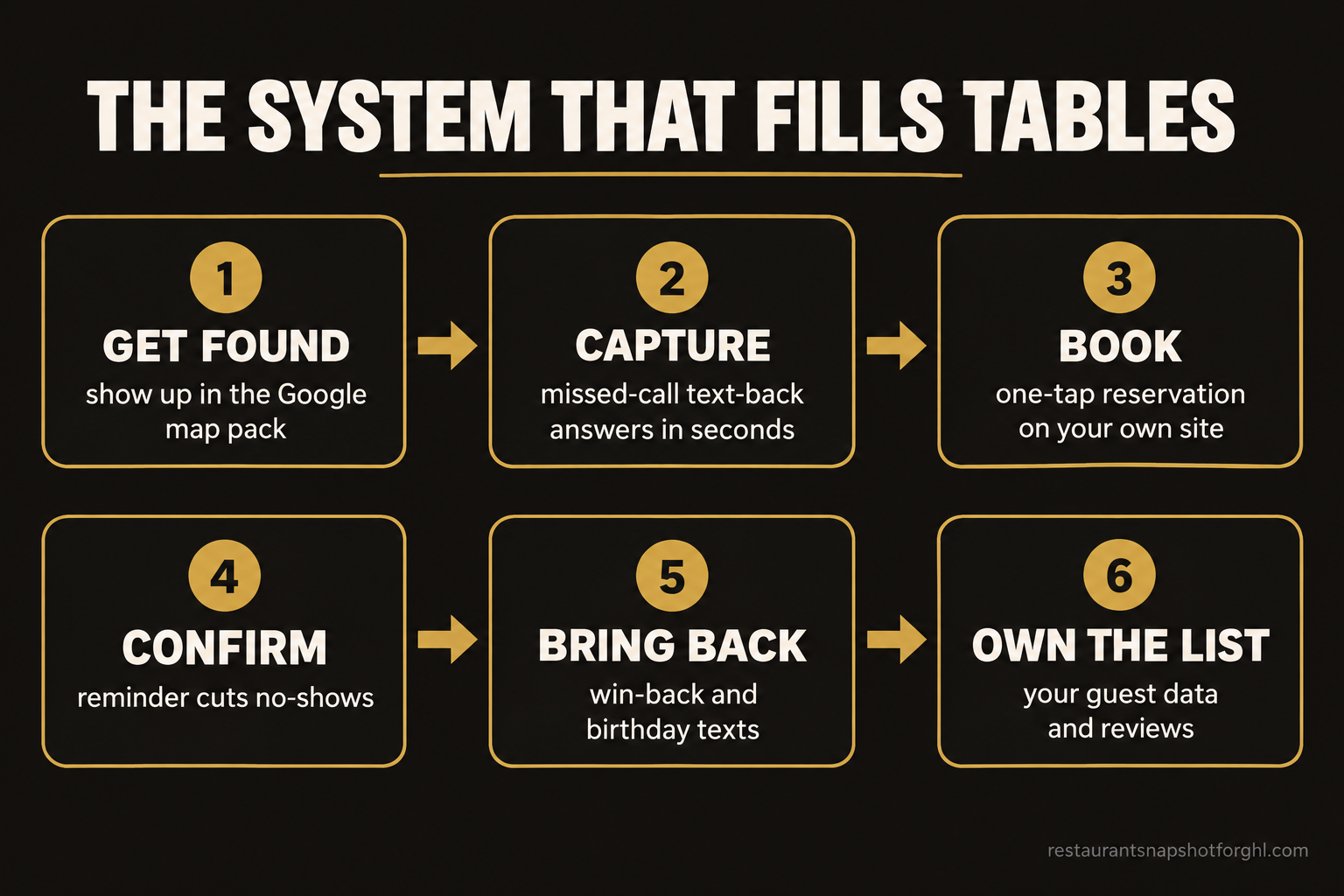
Stage 1: Get found before they reach the site
Claim and fully fill your Google Business Profile: correct hours, real photos updated monthly, the menu linked, and a steady drip of fresh reviews. This is what puts you in the map pack at 6pm. How it breaks: owners set it up once and never touch it, the profile goes stale, and a competitor with 40 recent reviews outranks you. Fix it by automating review requests (stage 5).
Stage 2: Capture every inquiry, instantly
Put a chat widget on the site and a missed-call text-back on the phone line. When a call rings out, a text fires within seconds: “Sorry we missed you, this is [Restaurant]. How can we help?” Now that caller is in a thread with you instead of dialing the next place. How it breaks: the auto-text has no human behind it during service, replies pile up, and guests feel worse than if you never texted. Fix it by routing overflow to a shared inbox or an AI assistant that can take a booking. See how the missed-call text-back plays out.
Stage 3: Make booking one tap
The reservation button should open a flow that works in three taps on a phone: no app, no account, no pinch and zoom. 59% of diners now prefer to book online, most on mobile (Toast). How it breaks: the button links to a clunky third-party page that asks too much and loses people halfway. Fix it by keeping the flow on your own domain and asking only for name, party size, and time.
Stage 4: Confirm the booking and cut no-shows
The moment a table is booked, send a confirmation text, then a reminder the day before with a one-tap “still coming?” This recovers tables lost to silent no-shows and frees the seat for your waitlist. How it breaks: the reminder fires too early or too late, so people ignore it. Fix it by timing it about 24 hours out and making reschedule a single tap.
Stage 5: Bring them back on purpose
This is the stage your website cannot touch and the one that pays for everything. Tag every guest and set up three flows: a win-back text to anyone who hasn’t visited in 60 to 90 days, a birthday club invite, and a monthly note about what’s new. How it breaks: operators blast the whole list the same message weekly until people opt out. Fix it by segmenting (lapsed, birthdays, VIPs) and keeping the cadence light.
Stage 6: Own the list and the reviews
Every booking, missed-call thread, and birthday club sign-up lands in one place you control, not a marketplace. From there you request a Google review at the right moment and route anyone unhappy to you privately first. Fresh reviews feed stage 1, and the loop closes. How it breaks: the data sits in three tools that don’t talk. Fix it by keeping capture, booking, messaging, and reviews together.
Steal this: the exact messages that do the work
The system is only as good as the words in it. Here is copy you can paste in today, brackets adjusted.
Notice the review message routes unhappy guests to you privately before they post. That is deliberate. A single-star increase in a restaurant’s rating is linked to a 5% to 9% revenue change, and the effect is largest for independents (Harvard Business School). Catching a bad night in a text beats reading it in public.
Run it for a solo spot, a busy independent, and a small group
The same system, sized to you.
Solo owner-operator, one location. Automation carries the load. Turn on missed-call text-back, booking confirmations, the day-before reminder, and the automatic review request; skip heavy segmentation and run one win-back flow and one birthday flow. Daily effort: checking the text inbox twice a day. This is where the leak is worst and the fix is cheapest.
Busy independent, one strong location and a real following. Retention is the opportunity now. Keep everything above and add segmentation: lapsed guests, birthdays, big spenders, and patio regulars each get their own light-touch message. Add a slow-Tuesday flow that texts only weeknight-friendly guests, so you fill Tuesday without discounting Saturday.
Small group, two to five locations. The trap is five disconnected websites and five separate guest lists. Consolidate into one system with shared guest data and reviews, but let each location keep its own Google profile and voice. This is also where renting covers from marketplaces quietly becomes your biggest line item, so owning the list matters most.
A website alone vs a website wired to a system
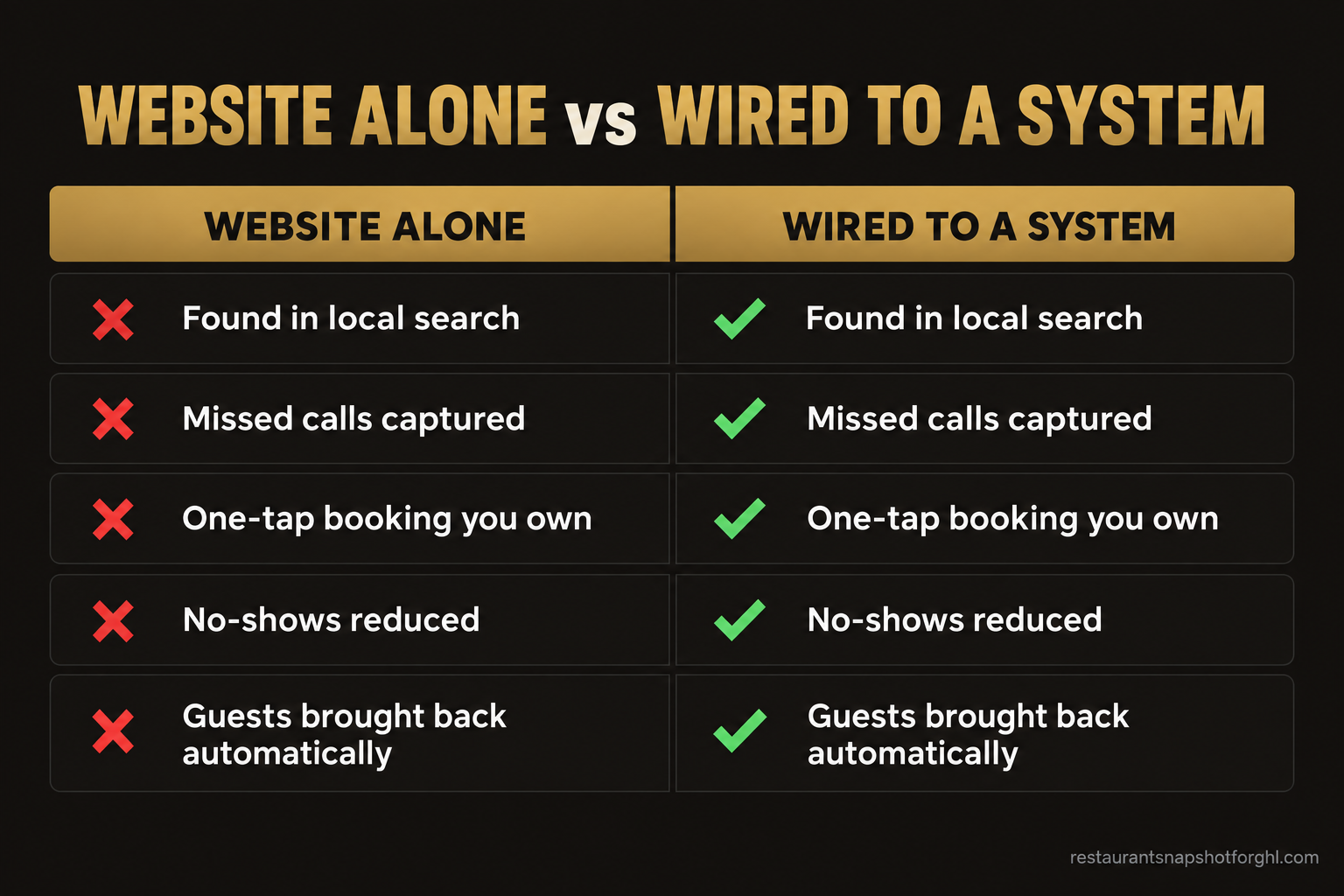
Same website, two very different outcomes
| Plan | Website alone | Website wired to a system recommended |
|---|---|---|
| Price | Looks good, sits still | Turns visits into covers |
| Feature 1 | Found only if someone already knows you | Found in the map pack via fresh reviews |
| Feature 2 | Missed calls leak to competitors | Every call and chat captured in seconds |
| Feature 3 | Booking often handed to a marketplace | One-tap booking on your own domain |
| Feature 4 | No-shows go unnoticed | Reminders cut no-shows, fill the waitlist |
| Feature 5 | No way to bring a guest back | Automatic win-backs and birthday invites |
| Feature 6 | Guest data owned by apps | Guest list and reviews owned by you |
| See the snapshot |
Keep it legal: texting guests without a fine
The moment your system texts guests, you are under the TCPA and A2P 10DLC rules, and restaurants get this wrong constantly. The classic violation is grabbing numbers at the host stand and blasting a promo without permission. Get it right and texting is your best channel.
- Get real consent. Collect the number with a clear opt-in that says you will text marketing offers. A booking confirmation is transactional and fine on its own; promotional texts need express written consent.
- Register for A2P 10DLC. Carriers now require business texting to be registered through your provider, with your brand and use case declared. Otherwise your messages get filtered or blocked.
- Honor STOP instantly. Every marketing text needs a working opt-out, and STOP has to remove the guest immediately. That is why the sample copy above includes it.
- Mind state rules on drink promos. Alcohol advertising and happy-hour discounts are regulated state by state, and several states ban time-limited drink specials outright. Scope any drink offer to your state’s rules, not a national template.
Build consent into how you collect numbers from day one and compliance takes care of itself.
Objections I hear from owners
“I just paid for this website, was it a waste?” Not at all. A fast, clean site is stage zero and you need it. The flat results are not a failure of the design; the website was never going to grow covers by itself. You bought the last three feet of the sale. Now add the mile in front of it.
“Won’t guests find the automated texts annoying?” They find irrelevant texts annoying. A confirmation, a helpful reply to a missed call, and a well-timed “we miss you” note are welcome. The annoyance comes from blasting everyone the same thing every week. Segment, keep it light, honor STOP, and opt-outs stay tiny.
“I’m not technical. Can I run this?” The setup is the hard part, and it is a one-time job. Once the flows are built, the day-to-day is checking a text inbox. If you can read a text you can run this. A done-for-you system or an install handles the technical piece.
“I already pay for OpenTable and a POS. Isn’t this redundant?” Those tools own your guest relationship and charge you per cover or per order to reach people who are already yours. This system sits on top and pulls that relationship back to you, so you stop renting access to your own regulars. It runs alongside your POS.
FAQ
Why isn't my restaurant website getting customers?
Because a website is a destination, not a demand engine. It converts people who already chose you, but it does not get you found in local search, capture the calls you miss during service, or bring past guests back. Those jobs need a capture-and-return system around the site.
Do I need a new website to fix this?
Usually no. If your site loads fast, reads well on a phone, and has a clear menu and booking button, you can wire the capture, booking, reminder, and follow-up system on top of it. Only rebuild if the site is slow or clumsy on mobile.
What actually brings diners in if not the website?
Being found in Google's map pack through fresh reviews, capturing every call and chat instantly, one-tap mobile booking, no-show reminders, and automatic win-back and birthday messages to guests you already have. The website is where they land, not what drives them there.
How much does a missed call really cost a restaurant?
Industry estimates put unanswered restaurant calls at 30% to 60% during peak hours and roughly $20 billion in lost business a year, because most callers do not try again and simply book the next place. A missed-call text-back recovers those inquiries automatically.
Is texting guests legal?
Yes, if you follow the rules. Collect clear opt-in consent for marketing texts, register for A2P 10DLC through your provider, and honor STOP immediately. Booking confirmations are transactional and lower-risk; promotional messages need express written consent. Scraping numbers and blasting promos is the classic TCPA violation.
How long does this take to set up?
The flows are a one-time build. A done-for-you install like the Restaurant Snapshot ships the whole system into your existing tools in about 24 hours, after which the daily work is just checking a text inbox.
So what do you do Tuesday?
Back to that half-empty Tuesday. The website is not the problem, and buying another one won’t move the needle. What moves it is the mile in front of the brochure: get found, catch the call you would have missed, make booking one tap, and text guests the fall menu six weeks later so they come back. Build those pieces yourself or have them installed, but either way, stop asking a brochure to do a system’s job.