
It’s the fifteenth of the month and your OpenTable invoice just hit your inbox. You open it between services, and the number is bigger than last month again. Not because you did anything wrong. Because you had a good month. More covers means more per-cover fees, and the platform that “sends” you those diners takes a cut of every one. You had a great Saturday, and your software billed you for it.
Almost nobody prices that out before signing. So let’s. This is an honest, numbers-first look at the four reservation platforms an owner-operator actually shops in 2026: OpenTable, Resy, Tock, and SevenRooms. Real monthly costs, the per-cover fees hiding under the sticker price, who owns your guest list, and which one fits a one-location spot versus a small group. No spin. Just the math.
Table of Contents
- The 30-second answer
- What per-cover fees actually cost you
- The side-by-side comparison (8 criteria)
- OpenTable, Resy, Tock and SevenRooms, one at a time
- Three real cost scenarios
- Owning your guest list instead of renting it
- The compliance part nobody warns you about
- How switching actually breaks
- Objections, answered straight
- Frequently asked questions
The 30-Second Answer
For most independent restaurants in 2026, the right move is a flat-rate platform for the reservation book, plus your own website and guest database for everything else. If you lean on the OpenTable marketplace to fill seats, you pay for that discovery on every cover, and the bill grows as you get busier. If you already have a following and just need a clean book, Resy or Tock at a flat monthly rate almost always costs less.
The short version by fit:
- You need diners you don’t have yet and will pay for reach: OpenTable, eyes open on the per-cover math.
- You have demand and want predictable cost: Resy (Amex crowd) or Tock (deposits, tastings, ticketed events).
- You’re high-volume or multi-unit with a marketing budget: SevenRooms, if you can stomach the contract.
- You want to stop renting guests entirely: take direct bookings on your own site and own the list.
What Per-Cover Fees Actually Cost You
A per-cover fee is a charge for each guest seated from a reservation, and OpenTable is built around it. Per 2026 pricing reporting, OpenTable’s plans run $149/mo (Basic), $299/mo (Core), and $499/mo (Pro), then add a per-cover fee on top: about $1.50 per “network” cover on Basic and $1.00 on Core and Pro, with a smaller charge (around $0.25) for covers booked through your own site (TableLink, 2026; RestaurantBookingSystem, 2026).
“Network cover” is the phrase that matters. That’s a diner who found you inside the OpenTable app, not one who came to you directly. You’re paying for the discovery: worth it when you genuinely need new faces, pure margin leak when the diner would have found you anyway.
Now watch what happens as you get busier. The monthly fee stays flat. The per-cover fee does not.
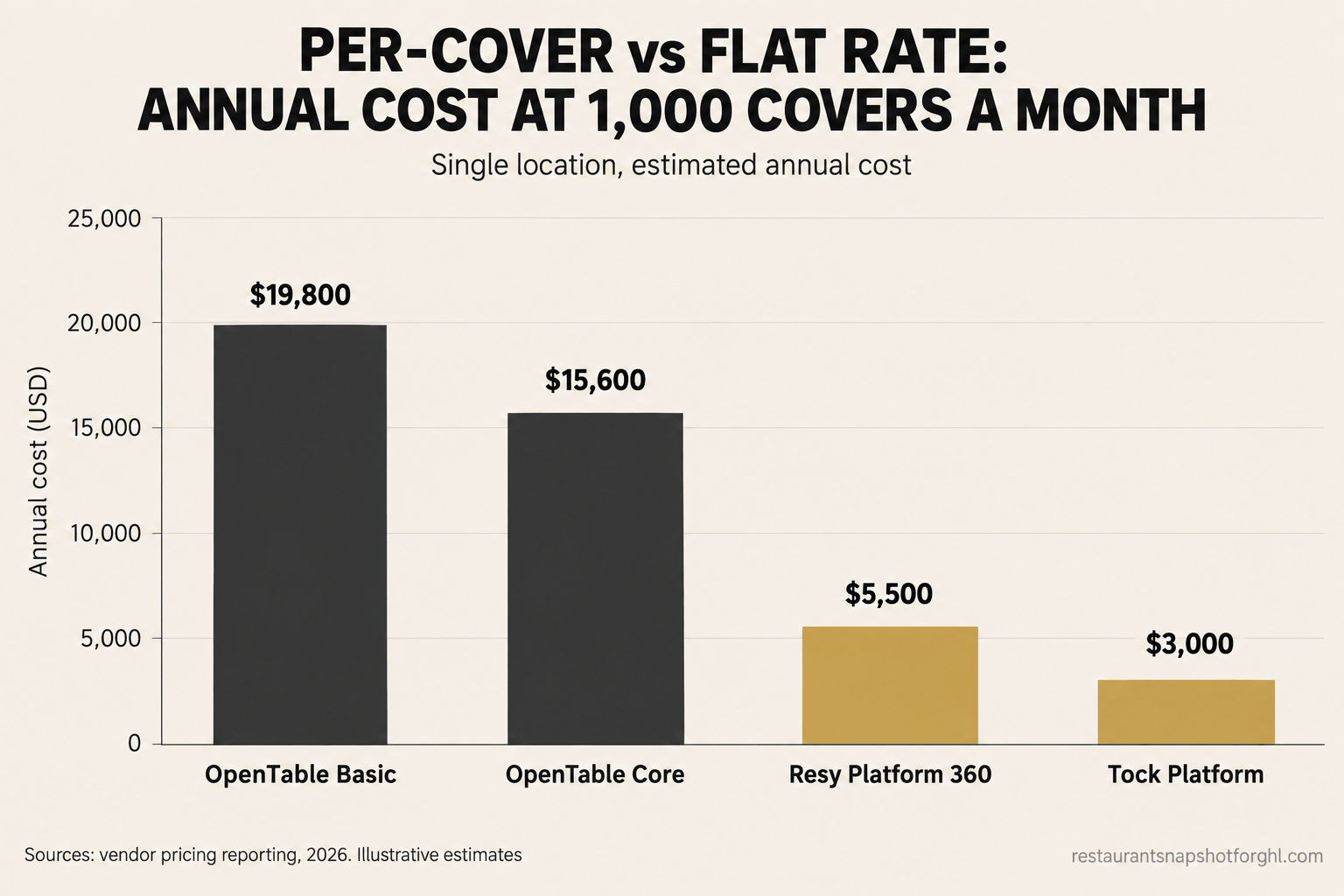
Estimated annual cost at 1,000 network covers per month, single location. OpenTable = monthly plan + per-cover fee ($1.50/cover Basic, $1.00 Core); Resy and Tock = flat monthly plan, no per-cover fee. Figures are illustrative, based on published-plan reporting. Sources: TableLink, 2026; RestaurantBookingSystem, Resy and Tock, 2026.
That gap is not a rounding error. At 1,000 covers a month through the marketplace, the per-cover model costs roughly $14,000 a year more than a flat-rate book. That’s a line cook’s wages, and the point of pricing this out before you sign.
The Side-by-Side Comparison (8 Criteria)
Here’s the head-to-head across the eight things that decide real cost and fit for an independent. Pricing reflects 2026 published-plan reporting; SevenRooms is estimated because it doesn’t publish rates.
| Criteria | OpenTable | Resy | Tock | SevenRooms |
|---|---|---|---|---|
| Entry monthly price | $149/mo (Basic) | $289/mo (Platform) | $249/mo (Platform) | ~$300+/mo (est.) |
| Top published tier | $499/mo (Pro) | $459/mo (360) | $399/mo (Premium) | Custom |
| Per-cover fee | $1.00 to $1.50 | None | None | None |
| Prepay / deposit fee | ~2% | ~2 to 3% | ~2 to 3% | Custom |
| Setup / implementation | Low | Low | Low | ~$5K to $25K (est.) |
| Marketplace discovery | Largest US network | Amex network | Smaller, curated | Minimal (CRM-led) |
| Cost predictability | Low (scales) | High (flat) | High (flat) | Medium (contract) |
| Owner of your data | Booking Holdings | American Express | American Express | DoorDash |
Sources: RestaurantBookingSystem, OpenTable / Resy / Tock / SevenRooms; G2, Tock; Capterra, SevenRooms. Prepay percentages vary by tier and change over time; confirm current rates with each vendor.
Three of the four charge a flat rate. Only OpenTable makes you pay per head, and only OpenTable hands you the biggest marketplace in return.
OpenTable, Resy, Tock and SevenRooms, One at a Time
Know who you’re signing up with, because the reservation business consolidated hard and it decides where your data ends up.
OpenTable (Booking Holdings): the marketplace tax. OpenTable has the diners. When someone searches “dinner near me tonight,” a huge slice look here, so the reach is real, especially for a new or off-the-path spot. The price is the per-cover fee, and in 2026 OpenTable also added a ~2% service fee on deposits and prepaid transactions (RestaurantBookingSystem, 2026). Where it breaks: it’s built to route diners through OpenTable, so their contact info and history live in its ecosystem. Cancel, and the diner still has the app; you don’t leave with the relationship you paid for cover by cover. Right call when: you need discovery you can’t create yourself and the new covers clear the math.
Resy (American Express): flat rate, Amex network. Pay a flat fee, seat as many as you can, never watch a per-cover meter. Reporting puts Platform around $289/mo and Platform 360 around $459/mo, no per-cover fees, low-single-digit prepay (RestaurantBookingSystem, 2026). Amex has owned Resy since 2019, so the network skews toward cardholders and buzzy urban rooms. Where it breaks: the network thins outside major metros, so a mid-size-city spot pays mostly for the book, not the discovery.
Tock (American Express): deposits done right. Built by Alinea co-founder Nick Kokonas to kill no-shows with prepaid reservations, Tock still shines there. For 2026, Platform runs about $249/mo, Essential $269, Premium $399, no per-cover fees, prepay around 2 to 3% (G2, 2026; RestaurantBookingSystem). For tastings, ticketed events, or wine dinners, it’s often the cheapest natural fit. Amex bought Tock from Squarespace for $400 million in June 2024 (CNBC, 2024), so Resy and Tock are now siblings. Where it breaks: discovery is the smallest of the group, and expect the two Amex products to converge.
SevenRooms (DoorDash): powerful, gated. The enterprise pick: deep CRM, guest profiles, and marketing automation the reservation-first tools don’t match. Two catches. First, the price is hidden, custom and fully demo-gated; operator reports cluster around $300 to $700+ per location per month with $5,000 to $25,000 setup fees and annual contracts (Reddit and review sites, unverified) (Capterra; PricingNow). Second, DoorDash bought it for $1.2 billion, closing June 13, 2025 (CNBC, 2025), so your guest data now sits inside a delivery giant. Where it breaks for independents: setup cost, contract length, and the “get a quote” wall put it out of proportion for a one-to-three location shop.
Three Real Cost Scenarios
The right answer genuinely differs by size. Here’s the framework run three ways, using published-plan reporting. All figures are estimates for comparison, not quotes.
Scenario 1: the solo operator. One location, ~300 network covers a month.
- OpenTable Basic: $149 × 12 + $1.50 × 300 × 12 = ~$7,200/yr
- Resy Platform: ~$3,500/yr · Tock Platform: ~$3,000/yr
At low volume the per-cover fee is survivable, but Tock or Resy still lands thousands cheaper.
Scenario 2: the busy independent. One location, ~1,000 network covers a month.
- OpenTable Basic: ~$19,800/yr · OpenTable Core: ~$15,600/yr
- Resy Platform 360: ~$5,500/yr · Tock Premium: ~$4,800/yr
This is where per-cover pricing stops being a rounding error. You could pay $10,000 to $15,000 a year more on OpenTable for the same seats, in exchange for discovery you may not even need anymore.
Scenario 3: the small group. Three locations, ~2,000 network covers per location per month (72,000 covers a year).
- OpenTable Core across 3: 3 × ($299 × 12) + $1.00 × 72,000 = ~$82,800/yr
- Resy Platform 360 × 3: ~$16,500/yr · Tock Premium × 3: ~$14,400/yr
At group scale the per-cover model can cost four to five times the flat-rate alternatives. That’s a real hire, or a real cushion for a slow quarter, gone to cover fees.
Owning Your Guest List Instead of Renting It
Here’s the part the pricing pages leave off the chart. Whichever platform you pick, ask what you walk away with. On a marketplace like OpenTable, the diner belongs to the marketplace: their app, their history, and the next “book again” prompt live with OpenTable, not you. On flat-rate platforms you keep more, but the relationship still runs through someone else’s system. The cheapest cover of all is the one a returning guest books directly with you, because you already have their name, number, birthday, and last order.
That matters more than ever, because diners want to come to you directly. In Toast’s 2025 reservation data, 65% of diners go straight to a restaurant’s website rather than a third-party app (Toast, 2025). And the money bleeding to marketplaces isn’t small: third-party delivery apps charge independents 15% to 30% commission per order, effectively 30% to 40% once fees stack, against a net margin that typically runs just 3% to 5% (Independent Restaurant Coalition, 2025; CloudKitchens). The through-line is the same: the more of your demand you own, the more margin you keep. A reservation platform can run your book. It shouldn’t own your guests.
The steal-this sequence. Once bookings run through your own site and the guest data is yours, this flow turns a single reservation into a regular. Copy it verbatim (swap in your name and hours):
Confirmation (right after booking): “You’re booked, [First name]. Table for [party size] at [Restaurant] on [date] at [time]. Reply C to confirm or R to reschedule. Directions + parking: [link]. Reply STOP to opt out.”
Reminder (24 hours before): “See you tomorrow at [time], [First name]. Running late or need to change your party size? Reply here. If plans changed, reply CANCEL so we can offer the table.”
Same-day nudge (3 hours before, large parties): “Quick one, [First name], still good for [party size] tonight at [time]? A yes locks it in and the kitchen preps for your group. Reply Y or CANCEL.”
Win-back (45 to 60 days after last visit, no return): “We miss you at [Restaurant], [First name]. Your table’s ready whenever you are: [direct link]. Reply STOP to opt out.”
That sequence lives in your CRM, fires on its own, and costs nothing per cover. For the deeper version, see our no-show recovery playbook and the 60-day silent win-back trigger.
The Compliance Part Nobody Warns You About
The moment you own the guest list and start texting it, you’re bound by the Telephone Consumer Protection Act (TCPA) and A2P 10DLC carrier rules. The classic violation in this niche feels harmless: grab numbers at the host stand, then blast a promo text. That’s marketing without proper consent, and TCPA penalties run $500 to $1,500 per message (FCC).
Two rules keep you safe. First, a reservation confirmation is transactional; a “half-price wine Tuesday” blast is marketing, and marketing needs its own opt-in. Second, every marketing message needs a clear opt-out. Compliant consent language for your booking form:
“Text me reservation updates and occasional offers from [Restaurant]. Msg & data rates may apply. Msg frequency varies. Reply STOP to cancel, HELP for help. Consent isn’t a condition of booking.”
Keep the transactional confirmation and the marketing opt-in separate, log consent with a timestamp, and honor STOP instantly and automatically. Unglamorous plumbing, and it’s exactly what keeps a small operator out of a settlement. Our full TCPA and A2P 10DLC guide covers registration and templates.
How Switching Actually Breaks
Leaving a platform is where good plans go sideways. The real failure modes, and the fix for each:
- You can’t export your history cleanly. Fix: before you cancel, pull every export the platform allows and capture new bookings into your own CRM in parallel for 30 days so nothing slips.
- You lose the Google “Reserve” link. Your reservation button in Search and Maps is tied to the platform. Fix: move your Google Business Profile booking link to the new system on cutover day, not a week later.
- You double-book during cutover. Fix: pick a hard switch date, freeze the old book to “no new reservations,” and run new bookings only through the new one.
- Your team defaults to the old habit. Fix: a 20-minute pre-shift walkthrough and a printed cheat sheet at the stand for week one.
- You go quiet and lose discovery. Fix: stand up direct booking, SMS reminders, and a win-back flow first, so your own demand engine runs before you cut the marketplace.
The order matters: build the direct channel, prove it fills seats, then cut marketplace spend.
Objections, Answered Straight
“But OpenTable brings me diners I’d never get.” Sometimes true, and worth paying for when it is. The test: of last month’s network covers, how many were genuinely new guests versus regulars using the app out of habit? You pay $1.00 to $1.50 for both. Keep OpenTable for real discovery if the math clears, but stop paying to re-seat people who already love you.
“Switching will tank my Google visibility.” It won’t, if you move the booking link on cutover day and keep your Business Profile, reviews, and website intact. Your rankings live there, not in the reservation platform.
“I already pay for OpenTable, so it’s a sunk cost.” Last month’s fee is sunk. Next month’s isn’t. The only question is whether the next twelve invoices beat a flat-rate book plus your own direct channel. For most busy independents, the numbers above answer that.
“I’m not technical.” You don’t have to be. A done-for-you setup installs the booking flow, the reminder sequence, and the guest database for you.
“Won’t guests be confused booking on my own site?” No. A “Book a table” button on your own site is what 65% of diners already look for (Toast, 2025). They’re loyal to your food, not to OpenTable’s interface.
Frequently Asked Questions
What's the cheapest reservation system for a small restaurant in 2026?
Among the named platforms, Tock's entry plan (around $249/mo, no per-cover fee) is usually the cheapest sticker price, with Resy close behind. But the cheapest cover overall is a direct booking on your own website: no per-cover fee, and the guest data stays with you. Run your real cover volume through the per-cover math before deciding.
Does OpenTable really charge per cover?
Yes. On top of the monthly plan ($149 to $499/mo in 2026 reporting), OpenTable charges roughly $1.00 to $1.50 per 'network' cover (a diner who found you through OpenTable), a smaller fee for site covers, and about 2% on deposits. Resy, Tock, and SevenRooms do not charge per cover.
Do Resy and Tock charge per-cover fees?
No. Both use flat monthly pricing with no per-cover fee. They charge a small percentage (roughly 2 to 3%) on prepayments and deposits, which only applies if you use prepaid reservations or ticketed events.
Why won't SevenRooms show its price?
SevenRooms uses custom enterprise pricing and is fully demo-gated, so rates depend on your size and features. Operator reports (unverified) cluster around $300 to $700+ per location per month with $5,000 to $25,000 setup fees and annual contracts. It's now a DoorDash company after the $1.2 billion acquisition that closed in June 2025.
Are Resy and Tock the same company now?
They're siblings. American Express owns Resy (since 2019) and bought Tock from Squarespace for $400 million in June 2024. Amex has signaled it will bring the two products closer over the next couple of years, so factor that direction into a long-term choice.
Can I switch reservation platforms without losing my regulars?
Yes, if you export your guest data first, capture new bookings into your own CRM in parallel for about 30 days, move your Google booking link on cutover day, and stand up direct booking plus SMS reminders before you drop the marketplace. Build the direct channel first, then reduce marketplace spend.
Related reading
- Online reservation system for restaurants: take direct bookings and cut per-cover fees
- The no-show recovery playbook for large parties
- Win back lapsed diners with a 60-day silent trigger
- Restaurant customer lifetime value: the number that changes every decision
- TCPA & A2P 10DLC: what restaurants need to know before sending one SMS
- Get the Restaurant Snapshot installed in 24 hours
Sources
- CNBC, American Express to buy Tock for $400 million (2024)
- CNBC, DoorDash announces $1.2 billion SevenRooms deal (2025)
- TableLink, OpenTable fees explained: up to $1.50 a cover (2026)
- RestaurantBookingSystem, OpenTable / Resy / Tock / SevenRooms pricing (2026)
- Capterra, SevenRooms pricing; G2, Tock pricing
- Toast, 2025 reservation data (65% book direct on the website)
- Independent Restaurant Coalition, third-party delivery apps and independents (2025)
- National Restaurant Association, 2026 State of the Restaurant Industry
- FCC, Telephone Consumer Protection Act (TCPA)