
It’s a Friday at the pass and your best server, the one who knows every regular by name, just pulled you aside to give two weeks. You do the math on the schedule in your head: who covers her sections, who you call, how long the postings take. That’s the cost you can see. The one you can’t see shows up nine weeks later, when the couple who came in every Friday for the Barolo and the window two-top just stops coming. Nobody complained. Nobody left a bad review. They came in for her, she greeted them like family, and when she left, so did the only thing holding them to your room.
That is the real bill for restaurant turnover, and it never lands on your P&L. The quiet, expensive part is that in most independent restaurants the guest relationships live in your staff’s heads, so when staff leave, the relationships leave too. Here’s what turnover actually costs, why it drains the regulars you spent years earning, and the system that keeps those relationships in the business.
Table of Contents
- The 30-second answer
- What turnover actually costs you
- The cost nobody puts on the P&L
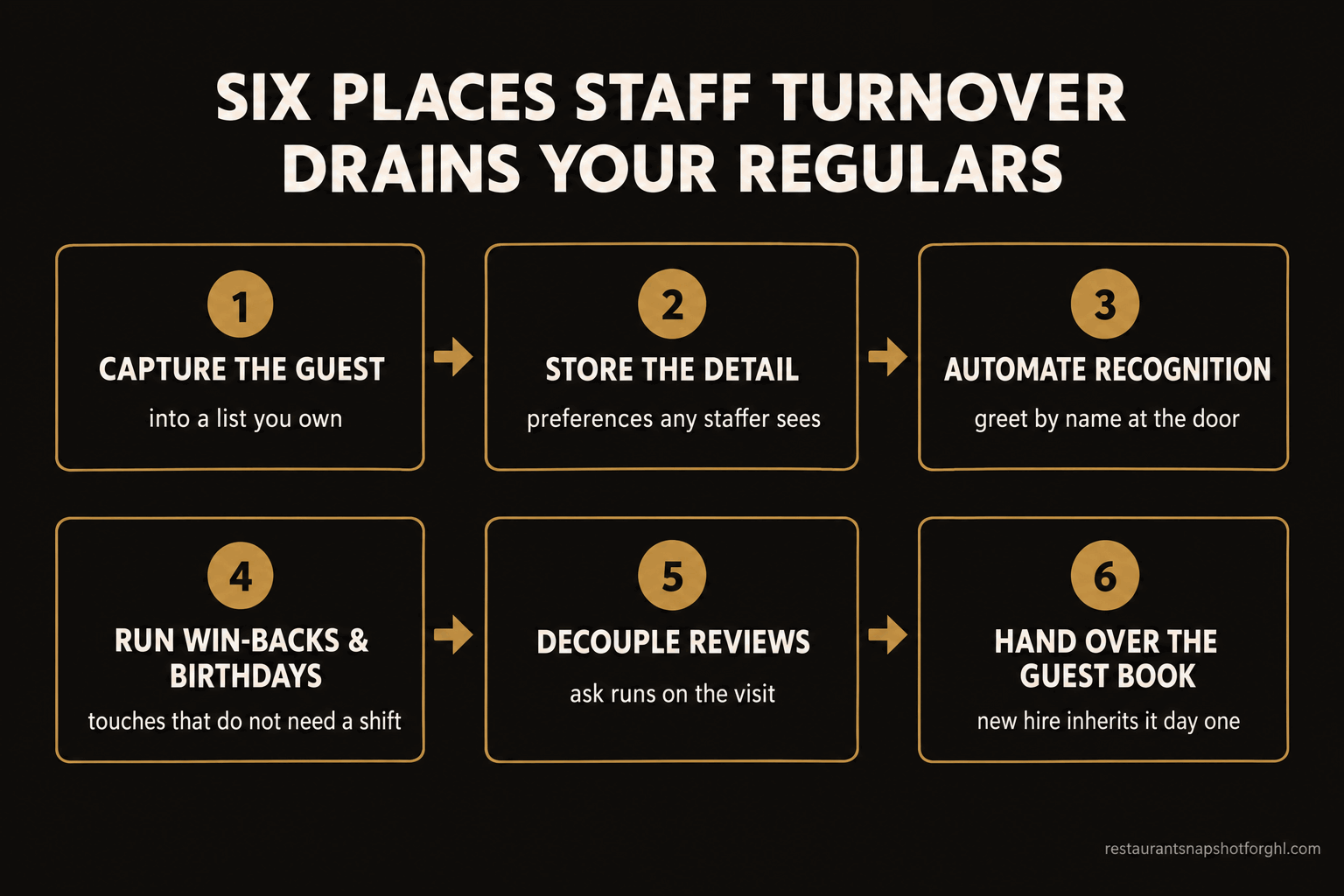
- The six places turnover drains your guests (and how to plug each one)
- The messages you can steal tonight
- Run the fix for a solo spot, a mid-size team, and a group
- The compliance part nobody warns you about
- Objections, answered straight
- Frequently asked questions
The 30-Second Answer
Staff turnover hurts you twice: once for the hire you replace, and a second, bigger time for the guest relationships that leave with the person. The replacement cost is manageable. The guest loss is the one that closes restaurants, because your regulars often aren’t loyal to your room. They’re loyal to the server who remembered their name, table, and order. When that server walks, the guest has no reason to come back, and you never find out why.
The answer is not to chase zero turnover, which you’ll never reach in this industry. It’s to stop storing your most valuable asset, the guest relationship, inside people likely to leave within the year. Move it into a system you own: names, numbers, history, preferences, and the follow-up that makes any guest feel recognized no matter who seats them. Then a resignation is a scheduling problem again, not a slow leak in your repeat business.
What Turnover Actually Costs You
Start with what you can measure. Restaurant turnover is among the highest of any industry, averaging roughly 79.6% (7shifts, 2025), so a typical independent swaps out close to four of every five people a year. The federal data agrees: the quits rate in accommodation and food services was 3.5% in August 2026, down from 3.9% a year earlier but still well above the private-sector average (U.S. Bureau of Labor Statistics). That’s the baseline you plan around, not the exception.
Every exit carries a hard cost. A 2025 survey of 511 U.S. operators put average replacement cost at $1,056 for front-of-house, $1,491 for back-of-house, and $2,611 for a manager (7shifts): recruiting, interviewing, onboarding, and the slower, error-prone service while the new hire finds their feet.
Average cost to replace one restaurant employee, by role, in U.S. dollars. From a 2025 survey of 511 U.S. restaurant operators. Source: 7shifts, The True Cost of Employee Turnover.
Multiply that by a roster. A 10-person independent, say six front-of-house and four kitchen staff at 80% turnover, replaces roughly eight people a year, around $9,000 to $10,000 in replacement costs alone, before comps for new-hire mistakes, manager hours re-training, and covers lost while a green server learns the floor. On independents’ thin margins, that’s not a rounding error.
And it’s happening with no room for waste: 60% of operators reported softer traffic in 2025 and 42% weren’t profitable (National Restaurant Association). Soft demand plus a five-figure turnover tax is the squeeze that sinks good restaurants. The hard cost is worth fixing, but it’s not even the big one.
The Cost Nobody Puts on the P&L
Here’s the part that shows up in no accounting software. Repeat guests drive about 60% of restaurant revenue (Olo), and in most independent restaurants the thing that makes a guest repeat is a person: the bartender who starts your drink as you walk in, the server who remembers you’re gluten-free, the host who says “your usual table?” before you’ve finished saying hello.
That recognition is the entire product for a regular. The food is why they came the first time; being known is why they came back forty times. In most restaurants that knowledge lives nowhere but in your staff’s heads, so when the server who holds it quits, the regular walks into a room of strangers, and a competitor two blocks away is one warm welcome from owning them.
You won’t see it happen, which is what makes it dangerous. Nobody fills out an exit survey when they stop being a regular. You get a softer month, then another, and by the time you notice the Thursday section has gone quiet, the guests are gone and you can’t ask why. Regulars rarely tell you they’re leaving, and turnover is one of the quietest reasons they go. Acquiring a new customer costs five to twenty-five times more than keeping one (Harvard Business Review), so every regular lost to a resignation is one you now re-buy at full price.
The Six Places Turnover Drains Your Guests (and How to Plug Each One)
None of this requires you to lower turnover, which you mostly can’t control. It requires you to stop keeping the guest relationship in a place that leaves. Here are the six points where turnover leaks guests, and the fix for each. Think of it as a system that remembers, so your people don’t have to.
Stage 1: Capture the relationship into a system, not a server’s memory
The leak starts at the first visit. A guest has a great night, says they’ll be back, and leaves no trace but a receipt. The fix is to capture every guest into a database you own at the moment they interact: a reservation, a Wi-Fi sign-in, an online order, a loyalty opt-in. The point is a name and number tied to a first visit.
How it breaks: operators assume their reservation platform “has” their guests, then discover the contacts belong to the platform. Owning your guest list instead of renting it from OpenTable is the highest-impact move here, because you can’t reach anyone when the server who knew them leaves.
Stage 2: Store what makes them a regular, where anyone can see it
A name and number is a contact. What turns it into a relationship is the detail: the Barolo, the window table, the gluten allergy, the March anniversary. When that lives only in one server’s head, it’s one resignation from gone. The fix is a guest profile any staffer can pull up: preferences, usual order, visit history, last time in, lifetime spend.
How it breaks: the notes exist but nobody updates them, so they rot. Build it into the close-out routine, the way you reconcile the till.
Stage 3: Automate the recognition so any server looks like an old friend
The next leak is at the door: a new hire can’t recognize a regular they’ve never met, but the system can tell them. The fix is to surface the guest’s history the moment they book or check in, a reservation note reading “returning guest, 11th visit, prefers the window, gluten-free,” so whoever works tonight greets them like the regular they are. The guest never knows a system did it; they just feel known.
How it breaks: the info is buried three screens deep and nobody looks during a rush. It has to land where the host already looks, on the reservation itself.
Stage 4: Keep win-backs, birthdays, and loyalty running regardless of who’s on shift
Regulars used to get a reason to return from the person who served them. “See you next Friday.” When that person leaves, the reasons stop. The fix is to automate the touches that don’t depend on anyone being on the floor: a birthday perk, a loyalty reward at a visit milestone, a win-back text when a regular’s rhythm breaks. They fire in your voice whether or not your best server is still around. It’s how you win back lapsed diners before they’re gone and turn a strong first visit into a second one.
How it breaks: the automations read like spam and get muted. Write them like the owner typed them, keep them rare, and they pull tables instead of unsubscribes.
Stage 5: Decouple reviews and follow-up from individual staff
In a lot of restaurants, review collection is “whoever remembers to ask,” which dies the moment that staffer leaves. The fix is to automate the review ask after a strong visit, routed so happy guests go to Google and unhappy ones come to you privately first. The pipeline runs on the visit, not on a person’s memory.
How it breaks: you ask everyone, including the table that had a bad night, and harvest one-star reviews. Gate the public ask behind a quick private check-in.
Stage 6: Hand the guest book to every new hire on day one
The last leak is onboarding. A new server starts cold, so for weeks your best guests get treated like strangers. The fix flips it: because the relationships live in the system, a new hire inherits the whole guest book on their first shift. They pull up table 12 and see the eleven visits and the Barolo. The ramp that took months now takes one login.
How it breaks: the system exists but nobody trains new staff to use it. Make “check the guest profile before you greet” part of the first-day script, next to how to run the POS.
The Messages You Can Steal Tonight
Here’s the actual copy: the touches that used to depend on a server remembering, rewritten so a system sends them in your voice. Swap your details and keep them short, so they sound like a person, not a platform.
The recognition note (host/reservation prompt, not sent to the guest):
Returning guest, 11th visit. Prefers the window two-top. Gluten-free. Usually orders the branzino with a glass of Barolo. Last in 3 weeks ago. Greet by name.
The second-visit nudge (3 days after a first visit):
Hi [name], it’s [owner] at [restaurant]. Really glad you came in this week, hope the [dish] lived up to it. If you’re up for a second round, reply and I’ll save you a good table. No rush, just wanted to say thanks for choosing us.
The win-back (when a regular’s usual rhythm breaks, e.g. 45+ days quiet):
Hey [name], [owner] here from [restaurant]. We haven’t seen you in a bit and the Friday table isn’t the same without you. Come back in this week and your first glass is on me. Reply STOP to opt out anytime.
The birthday perk (fires on the date, not on anyone’s memory):
Happy birthday, [name]! From all of us at [restaurant]. Come celebrate with us this month and dessert’s on the house, just show this text. Book here: [link]
The review ask (after a strong visit, gated):
Thanks for dining with us tonight, [name]. Quick one: how was everything, 1 to 5? (Reply with a number.)
A 4 or 5 routes the guest to your Google review link; a 1 to 3 goes to a private “So sorry, tell me what went wrong,” straight to the owner, so a bad night never becomes a public one-star.
Five touches, none of them dependent on which server is working tonight. That’s the difference between a relationship you own and one that quits when your staff does.
Run the Fix for a Solo Spot, a Mid-Size Team, and a Group
The system is the same at every size; the scale of the leak and the payback change. Here’s roughly what turnover’s replacement cost looks like across three operations, using the 7shifts per-hire figures at an industry-typical 80% turnover rate. Treat these as illustrative math on real per-head numbers, not a promise.
Estimated annual replacement cost by operation size, assuming ~80% turnover and the 2025 per-hire figures ($1,056 front-of-house, $1,491 back-of-house). Illustrative calculation on sourced per-head costs. Source: 7shifts.
The solo operator (one location, ~10 staff). Your turnover tax is roughly $9,000 to $10,000 a year, and each lost regular hurts more because you have fewer of them. Your move: get every guest into one list, tag your top 50 regulars by hand this month, and switch on the second-visit nudge and birthday perk. That’s an afternoon of setup. You’re the brand voice, so the texts should sound exactly like you.
The mid-size team (two locations, ~30 staff). Replacement cost climbs toward $30,000 a year, and a regular at one location is a stranger at the other. Your move: one shared guest database across both rooms, so a regular is recognized wherever they walk in, plus a manager routine for keeping notes current. The recognition prompt at the host stand earns its keep daily now that nobody knows everyone.
The growing group (five locations, ~100 staff). The turnover tax approaches six figures a year in replacements alone, and your guest relationships are spread across dozens of mostly-new staff. Your move: centralize the guest list, loyalty program, and review pipeline across all units, so the brand owns the relationship and no one location’s turnover can drain it. At this scale the system is the only thing between you and re-buying your guest base every eighteen months.
The Compliance Part Nobody Warns You About
The moment you start texting guests, you’re in regulated territory, and getting it wrong is expensive. The Telephone Consumer Protection Act (TCPA) requires prior express consent before you send marketing texts, with penalties of $500 to $1,500 per message (FCC). A2P 10DLC registration is the carrier-level process that lets your business texts deliver instead of getting filtered as spam.
The classic violation is the shortcut turnover tempts you into: a list of numbers collected at the host stand or off reservations, blasted a promo with nobody opting in. Collecting a number to confirm a booking is not consent to market. The fix is built into any decent system: a clear opt-in when you capture the guest, “STOP to opt out” on every marketing message, and automatic opt-out honoring. We go deeper in the guide to TCPA compliance for restaurant texts. Do it right once and it runs clean. Do it wrong and one complaint can cost more than a year of software.
Objections, Answered Straight
“My regulars come for my servers, not for a text.” Exactly right, and that’s the problem. If your regulars are loyal to a person rather than your business, you have your server’s regulars, and they leave when the server does. The system doesn’t replace a great server’s warmth. It lets the next server deliver the same warmth, because the knowledge is there to use.
“Won’t automated messages feel impersonal or creepy?” They feel impersonal when they read like a coupon machine, so don’t write them that way. The test: would it be weird if a thoughtful owner sent this by hand? If no, automating it just means it gets sent every time, not only when someone remembers.
“I can’t afford more software with my margins.” You’re already paying for turnover, around $9,000 a year for a small shop, plus the regulars you’re silently losing. The question is whether to keep paying that tax with nothing to show for it, or spend once to stop the leak. A single win-back campaign that recovers a handful of lapsed regulars tends to cover the cost.
“Do I need to be technical to run this?” No. The done-for-you Restaurant Snapshot installs in your GoHighLevel account in 24 hours with the workflows already built. Your job is to keep the guest notes current. If you can work a POS, you can run this.
Frequently Asked Questions
What is the average restaurant staff turnover rate?
The industry averages roughly 79.6%, among the highest of any sector (7shifts, 2025). Federal data puts the quits rate in accommodation and food services at 3.5% in August 2026 (BLS). Assume you'll replace most of your roster within a year.
How much does it cost to replace a restaurant employee?
A 2025 survey of 511 operators put average replacement cost at $1,056 for front-of-house, $1,491 for back-of-house, and $2,611 for a manager (7shifts). A 10-person shop at 80% turnover spends roughly $9,000 to $10,000 a year on replacements alone, before lost regulars.
Why do I lose regular customers when a server quits?
Because in most restaurants the guest relationship lives in the server's memory, not in a system. The regular came back because they were recognized; when that person leaves, so does the recognition. Repeat guests drive about 60% of revenue (Olo), so this quietly erodes your most valuable traffic.
How do I keep guest relationships when staff turn over?
Store the relationship in a database you own, not in people who leave. Capture every guest's name, number, history, and preferences; surface that history at the host stand so any server greets a regular correctly; and automate the win-backs, birthdays, and review asks so they run regardless of who's on shift.
Is it legal to text my restaurant guests?
Yes, with consent. The TCPA requires prior express consent for marketing texts, with penalties of $500 to $1,500 per message (FCC). Collect a clear opt-in, register for A2P 10DLC so messages deliver, and include STOP-to-opt-out on every text. See our TCPA guide for restaurants.
Won't lowering my turnover fix this on its own?
Lower turnover helps, but you'll never eliminate it in this industry, so building repeat business on staff who stay is a losing bet. The durable fix is to make turnover a scheduling problem again by keeping the guest relationship in a system that doesn't quit.
Turnover is the one restaurant problem you can’t fully solve, so solve the thing underneath it instead. The resignation on next month’s schedule is a given. Whether it costs you a hire, or a hire plus a slow bleed of your best regulars, comes down to where you’ve kept those relationships. Put them in a system you own, and your best server’s two weeks’ notice becomes what it should have been all along: a staffing gap to fill, not a quiet goodbye to the couple at table 12.