
It is the second week of November and the phone rings at 4:55pm, mid-setup for service. A woman wants dinner for fourteen on the first Saturday of December. Her office party. She mentions she has already called two other places. You scribble her name on the pad by the host stand, promise to call back, and then the room fills and you never do. You find the note Sunday under a stack of checks. You call. She booked somewhere else Friday night.
That was not a fourteen-top. That was roughly a thousand dollars of food and drink that walked to a competitor because nobody got back to her fast enough. This is the quiet way independent restaurants leave their best money on the table: a party inquiry that sat on a notepad.
Table of Contents
- The 30-second answer
- Why group bookings are the best covers you can chase
- The 6-stage system to turn an inquiry into a booked party
- Steal this: the exact messages
- Run it for your size: solo, busy independent, small group
- Phone-tag booking vs a real system
- Can you legally text party organizers?
- Objections, answered straight
- Frequently asked questions
The 30-Second Answer
Landing more group and holiday bookings is not about a bigger room or a flashier events menu. It is about answering faster than the other restaurants the organizer is calling, then removing every reason for the booking to fall apart. The organizer messages three places; the one who replies first, with a real answer and an easy way to say yes, usually wins. Below is the six-stage system, the exact messages, and how to run it at any size.
Why Group Bookings Are the Best Covers You Can Chase
A party of twelve is not just twelve covers. It is twelve covers that booked ahead, on a date you chose, often with a set menu and known spend per head. Next to the two-top that walks in at 8:15 and orders two waters, a booked group is the cleanest money in the house. And demand is growing: OpenTable reported group dining, parties of six or more, up 8% year over year in 2025 (Modern Restaurant Management, 2025).
The fourth quarter is where it matters most. ezCater’s 2025 workplace report found 82% of employees planned to attend their company holiday party, with food-and-drink spend averaging $59 per head, up 31% year over year (CFO.com, 2025). That pre-budgeted spending goes to whoever makes booking easy.
It is not just a December story. For restaurants that host events, private and group dining can run 20 to 30% of revenue (Gather, via MRM). Birthdays, rehearsal dinners, team dinners, client entertaining. Every one is a table you fill on purpose, and the organizer behind it is a repeat buyer who plans the same dinners every year.
The 6-Stage System to Turn an Inquiry Into a Booked Party
A group booking is a relay, and you lose the race at the handoffs: the inquiry that is hard to send, the reply that comes too late, the booking nobody confirmed. Here are the six stages, and for each, how it breaks.
Stage 1: Make the inquiry stupidly easy to send
Put a clear “Book a group or private event” option where people look: your site header, your Google Business Profile, your Instagram bio, the footer of your emails. Ask for only four things, name, date, party size, and best number to text. Every extra field costs you inquiries.
How it breaks: the form dumps into an inbox nobody checks during service, or a staff email that changes when someone quits. The fix: route every group inquiry to one place that pings a real phone instantly, as a text thread, not a form receipt. The organizer is on their phone.
Stage 2: Reply in five minutes, not five hours
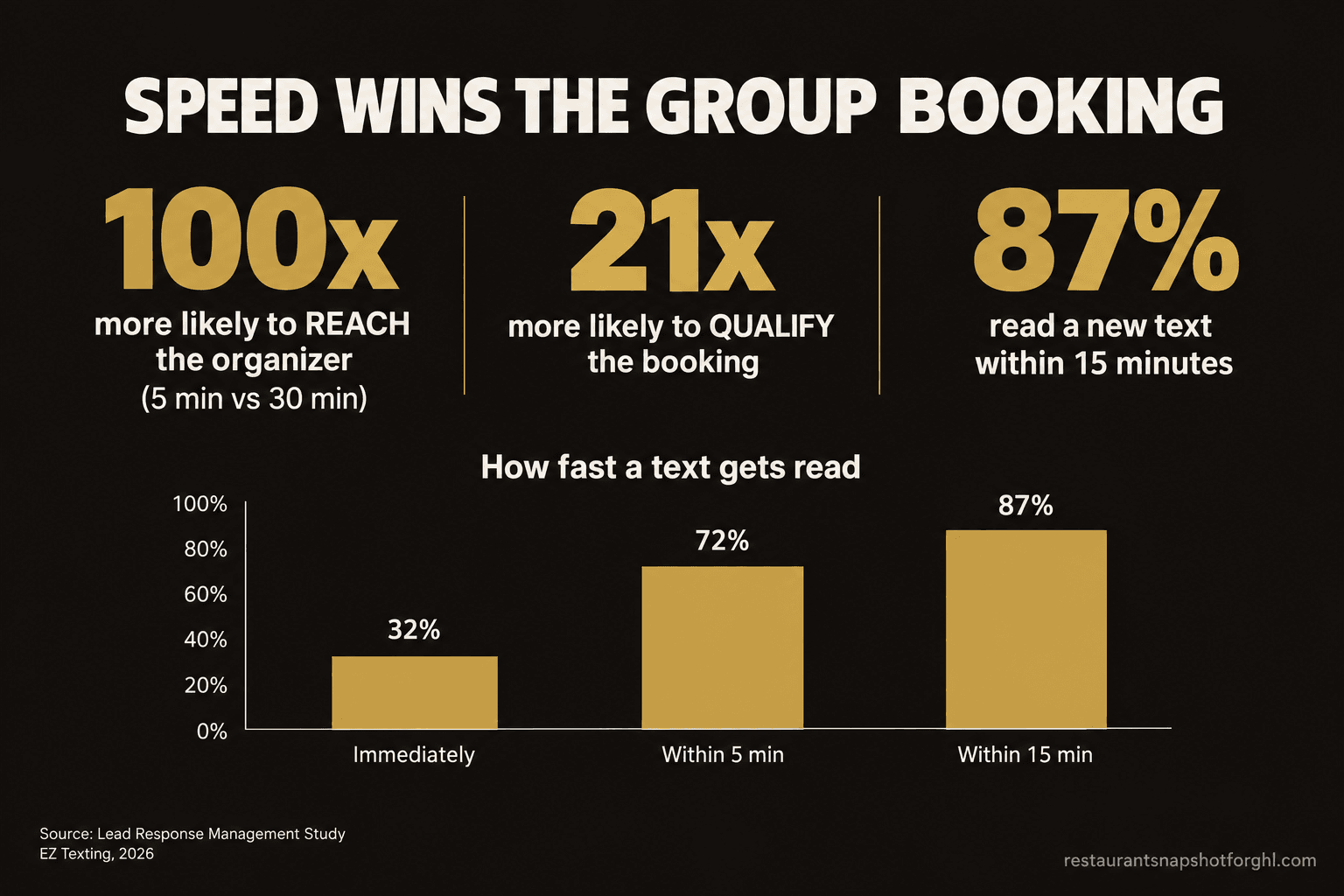
This stage wins or loses the booking. The Lead Response Management Study found that contacting an inbound lead within five minutes rather than thirty makes you about 100 times more likely to reach them and 21 times more likely to qualify them (Lead Response Management Study). The organizer is messaging competitors in the same ten minutes. First real answer takes the booking.
You cannot sit by the phone during a rush, so automate the first touch: the instant an inquiry lands, an automatic text confirms you have it, sounds human, and asks one qualifying question. A person follows within minutes. Texts get read fast, with 32% of people reading a new text immediately and 87% within 15 minutes (EZ Texting, 2026).
Share of U.S. consumers who have read a new text by each point (cumulative %). Source: EZ Texting 2026 Consumer Texting Behavior Report, ~959 U.S. adults.
How it breaks: the auto-reply is all you send, so the thread feels robotic. The fix: the automation buys time, it does not do the job. A person follows within minutes with real availability and a real suggestion.
Stage 3: Send a real proposal, not a menu PDF
Once the date works, do not email a 12-page menu and say “let me know.” Decide for them. Propose a set menu at a clear price per head, name the space you will seat them in, and give one link to say yes. A confident recommendation closes faster than a wall of options.
How it breaks: you offer the full menu to a party of eighteen, the kitchen drowns in separate orders, and the organizer remembers the chaos, not the food. The fix: set menus protect the kitchen and make your costs predictable enough to quote a confident price.
Stage 4: Lock it with a deposit and a clear policy
A verbal “we’ll take it” is not a booking. For parties above a threshold you set (eight is common), take a deposit that applies to the final bill, plus a card on file, through a secure link. That is how you block your best tables on your best nights without gambling. For the full playbook, see our no-show policy for large parties guide.
How it breaks: you skip the deposit to seem friendly, then a twenty-top cancels the morning of and you eat the food cost and the empty room. The fix: a fair, stated policy. Full refund or free rebook more than 48 hours out; you keep the deposit inside 48 hours because you have bought the food and turned away walk-ins.
Stage 5: Confirm and remind so the party shows
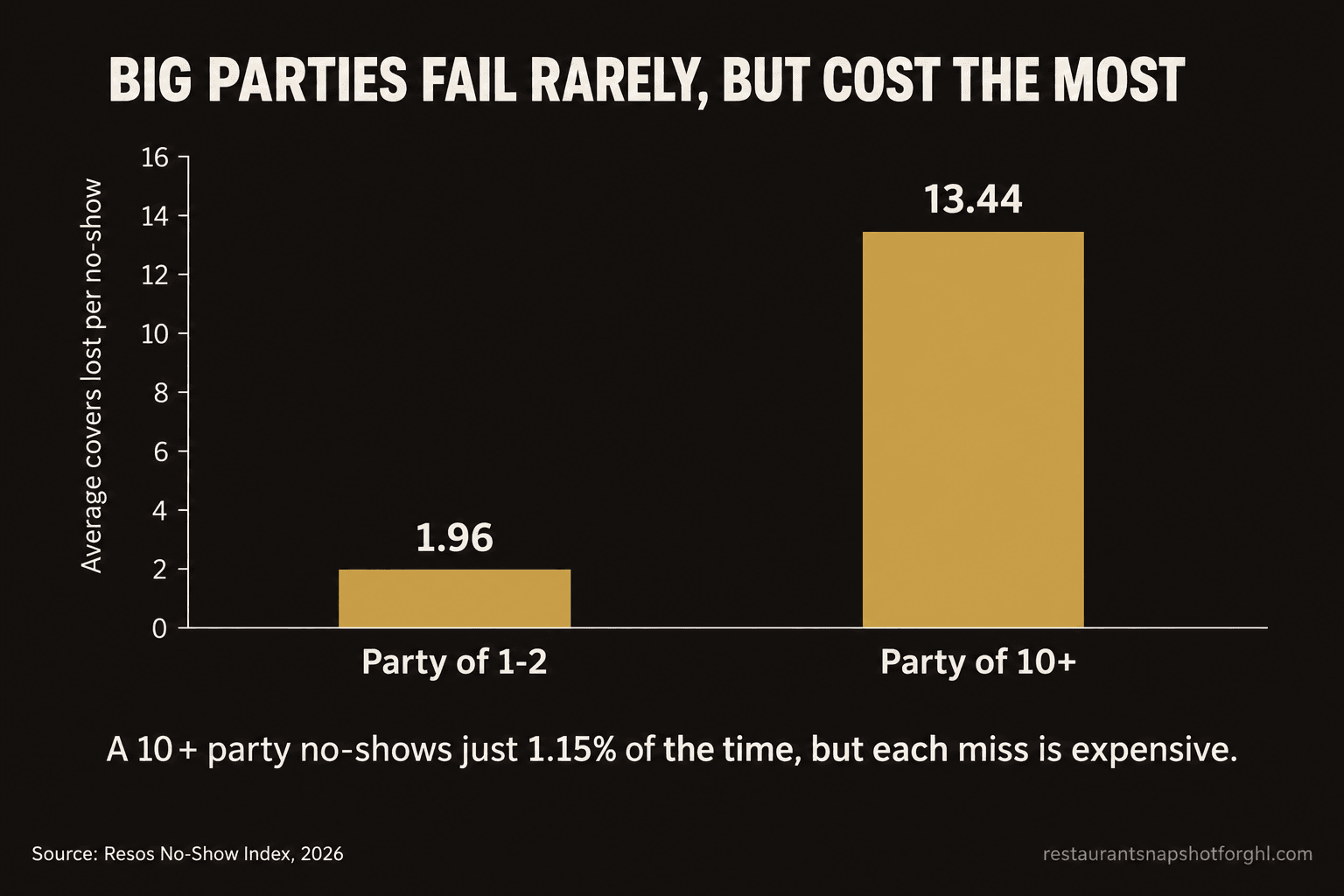
Big parties ghost rarely, but it hurts most when they do. The Resos No-Show Index for 2026 found a party of ten or more no-shows just 1.15% of the time, but each miss costs an average 13.44 covers versus 1.96 for a two-top (Resos, 2026). And 56% of cancellations land within 24 hours, exactly where a reminder earns its keep.
Run a short automatic sequence: a confirmation at booking, a headcount check 48 hours out, a warm day-of note. How it breaks: one reminder that reads like a legal notice gets ignored. The fix: keep it human and ask for one small action, confirming the final number, which catches a shrinking party early.
Stage 6: Work the night, then earn the rebook
A group dinner is a two-hour audition for every future party that table controls. Brief your staff with a one-page party sheet, the organizer’s name, the occasion, allergies, any surprise (a cake, a toast), the menu and timing, and make it travel with the booking, not the manager, so anyone on the floor can run the night. Then, the day after while it is still warm, reach back out. Thank the organizer, name something your team loved about their group, and offer to make it recurring: a monthly team dinner, a quarterly client night, next year penciled in now.
How it breaks: you never follow up, and next quarter the organizer cannot remember which of the three restaurants they tried was the good one. The fix: a day-after message and a note in your guest record turn one booking into recurring revenue, which almost nobody does. For the broader play, see how to turn first-time diners into regulars and how to own your guest list.
Steal This: The Exact Messages
Here is the copy. Swap in your details, keep the tone, and keep the STOP opt-out on any automated text.
Five of these six can fire automatically on the right trigger. Only the human reply in message two needs you, and that is the one worth your time.
Run It for Your Size: Solo, Busy Independent, Small Group
The seven stages are the same at every size. What changes is who does what.
The solo owner or small bistro. You are the sales team, the host, and the chef, and your enemy is the rush eating your response time. Automate the parts that do not need you, the instant reply, the deposit link, and the reminders, and keep the human reply personal. A big group would rather book with the name on the door than a faceless events desk.
The busy independent with a GM and a host team. Your enemy is the lead that dies between shifts. Route every group inquiry to one named owner, keep a shared calendar of held dates so two staff never promise the back room twice, and brief the floor off the party sheet.
The two-to-five-location group. Your enemy is inconsistency. Run one central pipeline with one shared policy and deposit flow, and when one spot is booked solid on a December Saturday, offer your room across town instead of losing the booking.
Phone-Tag Booking vs a Real System
What changes when you stop running group bookings off a notepad:
| What happens | Phone + notepad | A real booking system |
|---|---|---|
| Inquiry at 4:55pm | Scribbled, forgotten by Sunday | Auto-reply in seconds, you follow in minutes |
| First response time | Hours, if at all | Under five minutes |
| Holding the date | Verbal, nothing locked | Deposit and card on file |
| No-show risk | You eat the food cost | Reminders plus a deposit backstop |
| After the night | They forget you | Day-after rebook, saved in your guest list |
Can You Legally Text Party Organizers?
Short answer: yes, with consent, and the rules are stricter than most operators realize. When someone sends a group inquiry and gives you their number for that purpose, replying to arrange the booking is expected and fine. What you cannot do is take that number and start blasting Friday happy-hour promos. Marketing texts in the U.S. fall under the TCPA and the A2P 10DLC rules carriers now enforce: clear prior express consent, a working STOP opt-out, and honoring opt-outs immediately.
The clean way to handle it: use the booking thread for the booking, and ask separately whether they would like occasional offers and event news. Only the ones who say yes go on the marketing list. We go deep on this in our TCPA compliance guide for restaurant SMS, and if you run drink promotions, the rules for texting happy-hour deals differ by state.
Objections, Answered Straight
“We’re a small place, we don’t do ‘events.’” You do not need a ballroom. A six-top birthday, an eight-person work dinner, a twelve-person rehearsal is a group booking, and those are among your highest-margin covers. They fill the Tuesday nights walk-ins never will.
“Won’t an automated text feel impersonal?” The auto-reply is not the relationship. It is the receipt that tells the organizer a real human has their request, exactly what they are anxious about after messaging three places. Your human reply lands five minutes later and does the warm part.
“I already take bookings by phone and email. Why change?” Because phone and email are where group leads die: a voicemail at 8pm Friday, an email buried under reservations. The organizer who texted you also texted two competitors, and the one who answers first usually wins.
“Won’t deposits scare people off?” A clear, fair deposit scares off exactly the bookings you want gone, the flaky ones that cancel the morning of. Serious organizers expect a deposit and are reassured by it.
Frequently Asked Questions
How fast do I really need to respond to a party inquiry?
As close to instant as you can for the first touch, then within five minutes for a real human reply. Research on inbound leads found that responding in five minutes versus thirty makes you about 100 times more likely to reach the person and 21 times more likely to qualify them (Lead Response Management Study). Automate the first acknowledgement so the clock never beats you during service.
What size party should require a deposit?
Eight guests is common, but set it where a no-show would actually hurt. Large parties rarely cancel, but when they do it costs an average of 13.44 covers versus under two for a small table (Resos, 2026). A deposit that applies to the final bill protects those nights without feeling like a penalty.
Can I text a group organizer legally?
Yes, to handle their booking, because they gave you the number for that purpose. Marketing texts are different and require clear prior express consent under the TCPA and A2P 10DLC rules, plus a working STOP opt-out. Keep booking texts and promo texts separate. See our TCPA guide for restaurant SMS.
How far ahead should I chase holiday party bookings?
Start in October and push through November. Corporate spending is strong, with 82% of employees planning to attend a company party and food-and-drink budgets up 31% per head in 2025 (ezCater via CFO.com, 2025). Reach out to last year's organizers before they call anyone else.
Full menu or set menu for a large party?
A set menu or a tight limited selection. It keeps the kitchen from drowning in separate orders, keeps your food cost predictable, and gives the table a smoother night.
Back to That Fourteen-Top
Run it back. The office party inquiry lands at 4:55pm. This time the organizer gets an instant text with her name, date, and headcount before you have set the phone down. Eight minutes later you reply with the back room and a set menu at a price you are sure of. She says yes. A deposit link locks it, a reminder catches her final count, and the night goes beautifully because the whole floor had the party sheet. The next morning she pencils in the spring sales dinner.
That is the difference between a notepad and a system. The demand was always there. You just have to answer before the other restaurant does, then refuse to let the booking slip. Want more covers from guests you already have? Read how to fill slow weeknights without discounting and how to win back lapsed diners next.